Tuesday, January 7, 2014

Cold weather can produce hot fishing in the Sunshine State

Dave Robinson of Sarasota, Fla., shows off a cold-weather redfish that was caught in early afternoon.


It doesn't get all that cold in Florida. That's the main reason I moved to the Sunshine State back in 1971.

This trout came from a channel.
But every once in a while, the mercury will plummet , the wind will whip down from the north and we actually have to put on a pair of long pants (I own one pair).

When it does get severely cold, fishing tactics must change. Fish are affected, and anglers have to resort to different strategies.

Flash back to the freeze of 2010. That's the year fisheries biologists estimate at least 10 percent of the snook along Florida's west coast were killed by the cold. And few people even both to mention the number of jack crevalle, catfish and other species that perished.

During that period, most folks were having much difficulty catching fish in their usual spots. In fact, a 10-fish day was considered good.

I happened to discover a spot that held plenty of fish. I stumbled upon it, but realized there was a reason the fish were there. It was a channel connecting two bays and the deeper water was a degree or two warmer than surrounding areas. In addition, the channel's dark mud bottom absorbed the sun's warmth and held it.
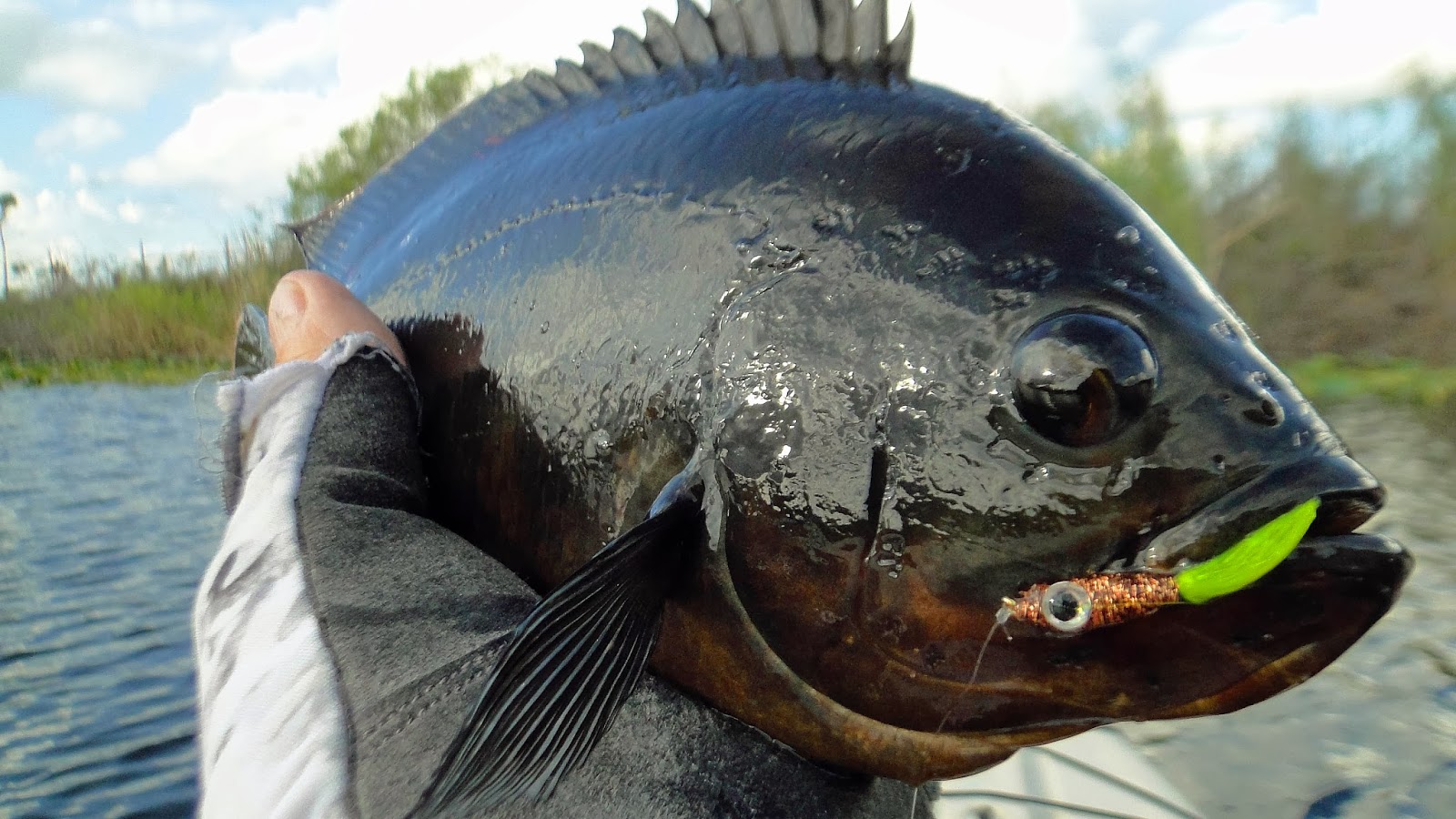
Small lures can pay off with large fish.

It was a luxury hangout for spotted seatrout, ladyfish, flounder, redfish and other species.

During that period, my clients and I averaged 50 fish per outing.  That pattern produced for a month.

Fish are cold-blooded. And when cold weather drops the water temperature, fish go into winter mode. Their metabolism slows and they don't feed as often or eat as much as they do in winter months.

So, your tactics must also change.

First, you must find the fish. That's an essential concept no matter what the weather. Find the fish, and you can usually figure out a way to catch them.

Once you find them, you've got to figure out how to catch them.

Scaling down my approach works best for me. I'll use smaller lures and work them slower than normal. My thinking is that a fish isn't going to expend more energy chasing down a bait that it will derive from eating it.

Typically, I will use a 1/16-ounce jig head and small grub during colder weather. I've also found that lures like the new Vudu Shrimp work well when worked slowly.

I use lighter lines than during the warmer months. My "go-to" rig has 5-pound braided line on it. And if targeting "non-toothy" fish, I'll go as light as 15-pound fluorocarbon for my shock leader.

Docks are great places to target winter fish. And you'll often find deeper holes around docks that are dug out by outboard engines.

A few years ago when I was the host of Fishing Paradise on SNN in Sarasota, we shot a segment on Charlotte Harbor. We found plenty of fish, but they were quite lethargic in the morning cold.

In early afternoon, we pulled into a cove that had a dark mud bottom. The fish were a little more active and we caught enough redfish on fly to produce a good show.

Canals often have deeper water, dark bottoms and docks. Those three ingredients are key to successful fishing.

When you're fishing in cold, it's wise to dress accordingly. I will layer so that I can remove clothing as the day warms up. In addition, to long pants, I'll wear a T-shirt, fishing shirt and jacket. I'll also wear neoprene flats boots.

In Florida, low tides and cold weather go hand-in-hand. When we have extreme low tides, sand holes are prime fishing spots. Fish sometimes have little choice but to drop into those holes until the tides comes up. And when that happens, it's like having your own private, stocked pond.

Tidal rivers are another option. Snook move into these rivers in good numbers during winter. The rivers usually are a little deeper, have water that's a few degrees warmer and dark mud bottoms.

Kayaks are perfect choices as fishing vessels during winter. They're stealthy, can navigate low water and are quite comfortable.

I own Southern Drawl Kayak Fishing (www.kayakfishingsarasota.com) and use Jackson Kayaks. My personal boat, a 14.5 Jackson Cuda, works well in virtually every situation.

When cold weather hits the Sunshine State, I'm usually prepared and able to catch fish.


December produced a variety of fish in a variety of conditions

Nick Roberts, 19, holds an impressive Myakka River snook that was caught on a MirrOlure Lil John on a light jighead.


December covered virtually every weather situation: sun, wind, rain, cold and warm.

Despite unpredictable and in consistent weather, fishing was fairly good.

Early in the month, Frank Jablonski of Venice joined us for an outing on Sarasota Bay. We fishing the deep grass off Stephens Point and managed 50 spotted seatrout, along with Spanish mackerel, bluefish and ladyfish. Most of the fish were caught on D.O.A. CAL Jigs with copper crush or gold paddle tails and the new VuDu Shrimp.

Vinny Caruso of Bradenton joined me for a day of fly fishing in the Everglades. The two of us combined to catch more than 300 fish, including oscar, largemouth bass, bluegill, stumpknocker and Mayan cichlid.

The Everglades visit showed us that the oscar have rebounded quite well following the 2010 freeze. Vinny and I estimated that we caught 150 oscar between the two of us. Our fish came on popping bugs and Myakka Minnows.

Fly anglers Chris Francis and son Graham from Montana joined me for a pair of outings and experienced slow conditions on one and decent production on the other. We fished the Myakka River on one trip, but couldn't find any snook.

We fished the deep grass off Stephens Point in Sarasota Bay and did fair. We caught 40 spotted seatrout, several Spanish mackerel, pompano, ladyfish, silver trout and sugar trout.

John Elliott and his son, Andrew, fished the river and had a fair day. They landed snook to 35 inches and a spotted on MirrOlure Lil Johns on light jig heads.

Tim Roberts and his son, Nick, were next up on the river. They managed three snook to 32 inches, a spotted gar and a small bass on Lil Johns on light jig heads.

Snook action on the river has been slow to date,  but I expect it to improve after the first of the year -- especially if we get some cold weather. I always tell clients that they're just one cast from a 25-30-pound snook when fishing the river.

Repeat client Jason Beary of Pennsylvania fly fished with me in Sarasota Bay off Stephens Point and did well. We totaled 40 spotted seatrout to 17 inches, four mackerel and several ladyfish on synthetic Clouser Deep Minnows and MirrOlure MirrOdines (mini).

Steve Sorrell of New York, also a repeat client had a decent day despite wind and cold. We fished the Buttonwood Harbor area along the west side of Sarasota Bay and caught flounder, spotted seatrout, redfish, snook, bluefish, jack crevalle, Spanish mackerel and ladyfish on D.O.A. CAL Jigs with paddle tails, MirrOlure MirrOdines and Johnson Sprite Spoons.

I look for large snook action to improve on the Myakka River. Last year, the first and second weeks of January were the top periods for snook. We caught snook up to 44 inches, along with several small tarpon during that period.

In Sarasota Bay, I look for continued action on spotted seatrout, jack crevalle, bluefish to 5 pounds, Spanish mackerel to 5, redfish, flounder and, of course, ladyfish.

Happy New Year and good fishing!


Steve Gibson
Southern Drawl Kayak Fishing
www.kayakfishingsarasota.com

(941) 284-3406

Friday, December 13, 2013

Oscar are sipping flies and bending rods in the Florida Everglades

Vinny Caruso of Bradenton, Fla., battles a feisty Everglades oscar on fly rod.


The trip was no different than any others: oscar and Mayan cichlid sipping flies like construction workers at happy hour.

The action was THAT good.

This oscar took a copper Myakka Minnow.
It usually is in the Florida Everglades where exotic species --  along with native species -- are plentiful and ever so willing to provide fishing fun.

That trip took place on Dec. 17, 2009.

A month later came the day the fishing died. The freeze of 2010 was so severe it killed several hundred thousand fish (or more) across the state. Snook, which were severely impacted, got the headlines. The exotics virtually were ignored.

I understand why. Oscar, Mayan cichlid and other exotics aren't native to Florida. Fisheries biologists think the first exotics were unceremoniously dumped into south Florida waterways as far back as 1954. They theorize a frazzled aquarium owner chose to dump the fish rather than transport them on a move north. Or perhaps they simply got tired of taking care of the critters.
Paul Drewry of Michigan holds a whopper oscar.

Whatever the reason, the exotics are here to stay.

I don't mind that at all. In fact, I rather enjoy catching them on light fly rods.

But that hasn't been too easy over the past four years. In fact, my treks to the Everglades yielded little more than largemouth bass, bluegill, shellcracker, stumpknocker and speckled perch during that span. For the first three years after the freeze, I caught no oscar and less than a half dozen Mayan cichlid.

Things began to change last spring when Patrick O'Conner of Rotonda and I made the 2 1/2-hour drive south. We didn't exactly tear the exotics up, but we did pretty well. We combined to catch 30 oscar amount out bounty of other species.

So, when Vinny Caruso of Bradenton drove to the 'Glades  on Dec. 10, we had great expectations.

Myakka Minnows are the ticket to Everglades' success.
We weren't disappointed.

I'm happy to say, the oscar are back!

We caught at least 125 oscar -- and maybe more.

Let the good times roll!

I figured the exotic species would rebound. Severe freezes occur in Florida from time to time. So, fish kills are somewhat common. The exotics are tropical fish and cannot tolerate water temperatures much below 60.
But you have to figure that no matter how severe the freeze, every exotic is not going to be killed. As long as one male and one female survive, there's a chance to sustain the species. It took four years, but the oscar appear to have rebounded.

We only caught one Mayan cichlid, but that doesn't mean too much. I caught several Mayans post freeze in other locations. In fact, a buddy of mine, Dave Robinson of Sarasota said he and a couple of others caught all they wanted last year just south of Marco Island.

Could have been there just weren't that many Mayan cichlid where we fished.

What's the attraction?

It's threefold: 1. They're plentiful; 2. They're aggressive; 3. They fight better than any fish for their size.
I target the exotics only with fly rod. Most often I employ a 3- or 4-weight fly rod (I used Temple Fork Outfitters Finesse series) with floating line and 7 1/2-foot leader. While tiny tippets are the rule when fly fishing for panfish, you'll have to beef up when you target exotics. They like to hang out around structure and their first move is back into that structure. So, rather than the usual 5X (4-pound test) tippet, you'll need at least 4X or even 3X.

When you hook an oscar or Mayan, they'll make a strong, quick lunge back into the structure. It's you job to keep them out. If you fail, you'll most likely lose the fish and your fly.

It was Caruso's first time fishing for exotics. He was impressed. He couldn't believe that small fish could actually tow his kayak during the fight.

"i lost quite a few flies," he said. "It took me a while to get used to their strength. They're a lot stronger than other fish their size."

The average oscar weighs about 3/4 of a pound. A really large one will push 1 1/2 pounds.

But don't let their size fool you. Tie an oscar tail to tail with a bass, and the oscar will pull the bass inside out!

The International Game Fish Association all-tackle world record oscar weight 3 pounds, 8 ounces. It was caught by Jay Wright Jr., from Pasadena Lakes (Florida) in 1999. A friend of mine, Marty Arostegui of Coral Gables, holds several tippet class world records for oscar.

The biggest oscar I've even taken weighed an estimated 3 pounds. I caught that fish on a popping bug in a Picayune Strand State Forest waterway in 2006.

We usually start out fishing with No. 10 popping bugs. I like chartreuse (I use Boogle Bugs), but I'm not certain color makes too much difference.

When the topwater bite ends -- it usually doesn't a  couple of hours after sunrise -- I switch to my Myakka Minnow, a fly that has produced thousands of fish for me over the years.

One Myakka Minnow will last the whole outing, providing you don't break off.

For information on that great fly, just "google" Myakka Minnow. Or you can drop me an email: steve@kayakfishingsarasota.com.

We didn't experience one of those great days in the 'Glades, but it was good enough. In addition to oscar, we totaled 80 largemouth bass (mostly small), 30 bluegill, 25 stumpknocker and a few shellcracker.

I don't know much about using spinning gear in the 'Glades, but I would imagine ultralight tackle would work just fine. Couple that with 6=pound line and you're in business. Beetle Spins (1/32-ounce), small jigs and tiny topwaters should produce all the action you want.

I fish the 'Glades from my kayak and offer kayak trips. For fly fishing, I've found my Jackson Kilroy (http://jacksonkayak.com/jk-kayaks/kayak-fishing/2013-kilroy/)  to be a superb boat. It's roomy, stable and uncluttered -- perfect for fly fishing.It's the best kayak for fly fishing that I've ever used.

I limit my Everglades outings. I usually begin in December and will fish through April. That's when the water level is at its lowest. Low water concentrates the fish.

I avoid the rainy season. Not only are the fish able to spread out over millions of acres, but the heat, daily thunderstorms and mosquitoes aren't fun.

Though I offer Everglades charters, I hesitated over the last four years. That's a long way to go for less than stellar action.


But it appears that the exotics have recovered. So, I'm happy to say I'm looking forward to the long drives once again.

Wednesday, November 27, 2013

November fishing report and December forecast

Pete Wolocko is a happy camper after landing this fine Sarasota bay redfish.
November was a month of wind, rain, sun and calm conditions.

It also was a month of redfish, snook, spotted seatrout, bluefish and Spanish. The only thing missing was pompano, a species that usually shows up in good numbers around Sarasota Bay in November. Perhaps we'll catch plenty of pompano in December.

We did a lot of fly fishing in November. Most of the action took place in the shallows and deep grass around Buttonwood Harbor on the west side of Sarasota Bay off Longboat Key. We did pretty well, casting Gibby's TK Flies and synthetic Clousers.

Trout, snook and redfish were holding the edges of the shallow flats on the outing tide. We did best while wading the edges and casting the TK Flies on full floating lines. In addition to snook, trout and reds, we also managed bluefish, Spanish mackerel, jack crevalle and ladyfish on the edges of the flats.

It's good to see jacks back. They were hurt critically during the freeze of 2010 and it has taken this long for them to rebound. After the freeze, we weren't catching a half dozen jacks a year. Things improved slowly year by year. Now, we're catching up to a dozen jacks per outing -- and they're pushing four and five pounds! I'm think that next season we'll see a bunch of seven- and eight-pound jacks.

That's great news!

Longtime client Pete Wolocko of Michigan joined me for an outing and had a decent day. Using MirrOlure Lil Johns on light jig hads, Wolocko caught spotted seatrout to 20 inches, jack crevalle and a 30-inch redfish. We were fishing inside Buttonwood Harbor along the edge of a grass flat.

Denton Kent of Washington D.C. fly fished the shallows with me on a strong outgoing tide. He totaled 15 spotted seatrout to 18 inches on TK Flies.

Vinny Caruso of Bradenton fished a number of trips. He decided to take up fly fishing and only used a fly rod during the month. He did well. Caruso caught quite a few spotted seatout to 22 inches, plus jack crevalle and ladyfish. He hooked one redfish, but wasn't able to land it.

We'll start to explore the Myakka River and will begin concentrating on the stream by mid-December. We usually begin fishing the Myakka in December and fish it heavily through mid-February. Last season, clients caught snook to 42 inches, plus redfish, tarpon, gar and largemouth bass.

On two occasions last season, we came within a largemouth bass of a Super Slam (snook, redfish, tarpon, gar and bass).

These trips book early so that you're assured a trip (or two).

We're going to put more of an emphasis on fly fishing the river, but we'll also do plenty of spin fishing.

While December is mainly a river month, bay fishing should produce trout, pompano, redfish and jack crevalle.

We'll also do our share of freshwater fishing. Local lakes and rivers should produce plenty of bluegill, shellcracker, stumpknocker, tilapia, channel catfish and largemouth bass.

Everglades trips are expected to result if all of the above, plus oscar and Mayan cichlid.

Happy Holidays!

Steve Gibson
Southern Drawl Kayak Fishing
www.kayakfishingsarasota.com

941-284-3406


Tuesday, November 26, 2013

So you want to become a kayak guide? Here are a few tips


This client is a happy camper after landing this fine Sarasota Bay redfish.


So, you want to be a fishing guide?

You went to bed, dreamed of being a guide, then woke up the next morning and decided you are one.

Simple.

Not!

The kayak fishing guide profession is a rather new phenomena since kayak fishing itself is rather new. Seems as if everyone and his/her  brother/sister is a kayak fishing guide these days.

I've been guiding since 2005 and full-time since 2009. During that time, I've seen a whole bunch of wide-eyed neophytes become guides and I've seen a bunch become disenchanted and quit.

There are many reasons to become a guide.

I became a guide via a suggestion from my wife, Kathy.

"You're all the time take people fishing and they always seem to catch fish," she told me one day a few years back. "You ought to become a guide."

At first, I resisted. But the more I thought about it, the more sense it made. I made the decision and jumped into the endeavor head-first. I haven't regretted that decision for a second. I run Southern Drawl Kayak Fishing (www.kayakfishingsarasota) in Sarasota, Fla.

Here are a few things you'll need in order to hang your shingle:

Kayaks: You'll need as many as the amount of anglers you'll anticipate taking fishing. I prefer to limit the number of anglers I take to two. So, I have three kayaks. I have two Jackson Cudas and a Jackson Kilroy.

Rigging: You'll need to rig each kayak. I rig mine with anchor trolleys, anchors and rod holders.

Paddles: Of course, you'll need one for each kayak. I use Aqua-Bound Paddles. I find it wise not to skimp when it comes to paddles (for you or your clients).

Safety equipment: Personal floatation devices and whistles (or air horns) are required. And you'll need lights if you plan to fish in the dark.

Tackle: I like to carry two rods and reels per anglers. So, if I'm taking two out, I'll need four rigged rods and reels. And since there are a variety of fishing scenarios, I have rods ranging from light to medium heavy. In all, I have 16 spinning rods and reels.

Lures: You'll want to carry an assortment, ranging from topwater plugs to jigs. I do not fish with live bait, so I have plenty of artificials from which to choose. I am sponsored by MirrOlure and D.O.A. Lures. Your clients will go out and buy the lures that you use after they've caught fish on them.

Fly tackle: If you plan to take fly anglers, you'll need tackle for them. I usually carry rod rigged with a sinktip line and another with a floating line. I am sponsored by and use TFO Fly Rods.

Freshwater gear: There's a demand for freshwater trips in Florida. I specialize in fly fishing for bass, panfish and exotics. I have six fly rods and reels suitable for this venture.

Other gear: I also carry rain gear for my clients. In addition, I take a first-aid kit on every trip, along with duct tape, screwdriver, pliers, toilet paper, sunscreen, etc. You never know what emergency might arise. And don't forget a cooler. You'll need to carry cold drinks on every trip.

Camera: I always tote along a camera to get photos of my clients fighting fish and/or posing with catches. I try to email photos of clients the afternoon after a trip.

Liability insurance: You're a fool if you take anglers fishing for money and don't have insurance. You may never need it, but you'll be glad you have it if the situation arises.

Website: An essential. It's imperative to have an attractive and up-to-date website. And you'll need to work the Internet almost daily when you're not on the water in order to get your services and your website exposure.

Knowledge: You can't buy this. You have to earn it the good, old-fashioned way: hard work. If you don't have a charter, you need to be on the water. Nothing's worse for a guide than to book a trip for the next day, but you haven't been out in a week or longer. Some call it fraud.

Personality: Your clients sometimes will endure a slow day. It might not be your fault, but you can insure that they have a good time by keeping things lively. Make sure you have a good knowledge of your local fish, flora and fauna.

Clean equipment: You'll need to clean all of your equipment after every trip. It usually takes me at least an hour to prepare for a trip and another hour to clean my equipment afterwards. Clients expect clean and well-maintained equipment.

Business sense: Run your charter service as a business. Remember to tuck money away for lean times and whenever the need might arise. You'll find that rods break, reels get dunked and lures are lost. And there are slow times of the year when the phone doesn't ring.

Exposure: Your phone probably won't start ringing just because you decide to be a guide. You'll need to get the word out. Join local kayak fishing forums and be a regular contributor. Speak at kayak clubs in your area and around your region and state. Many fear public speaking, but it gets easier as time goes by.

As you can tell, becoming a kayak fishing guide can be a costly endeavor. You can offset the cost somewhat by obtaining sponsorships. Many kayak manufacturers have guide and or pro staffs and offer discounted products to them. Ditto for those companies who make rods, reels, lines and lures. To obtain sponsorships, you can start by sending a query email and attaching your bio.

It's important that you don't abuse the sponsorship. Offer to assist at shows, demo days, etc. And talk your products up to your clients during every trip. Over the years, I've had more than 30 clients go out and buy the brand of kayaks I use.

I also do not seek sponsorships for sponsorships' sake. I only want to be associated with products that I use and believe in. What could be more worthless that to get a sponsorships for products that you don't or rarely use? Might look good on your sponsor list, but it's not right or fair.

One last tip: The way to make a small fortune in the guide business is to start out with a large fortune.

Good luck!


Sunday, October 27, 2013

October (Florida's best month) lives up to its reputation

Vinny Caruso of Bradenton battles a 70-pound blacktip shark.
October, arguably, is the best month in Florida -- for a number of reasons.

One, the weather is superb. Two, fishing is great. And, three (for the most part), the water is uncrowded.

Oh, did I mention that traffic is pretty light?
Geoff Henderson and pompano

Vinny Caruso of Bradenton enjoyed several good days of kayak shark fishing. We fished southern Tampa Bay and did pretty well. We caught and released a number of blacktip and bonnethead shark to 70 pounds.

We like to arrive at daylight and paddle to the shark grounds. Once there, we spend a little time catching bait.

We use light jigs to target ladyfish or whatever else we might catch.

For shark fishing, we use Star Seagis medium heavy rods, Shimano TLD 15 reels, 30-pound Power Pro braided line and wire leaders with 8/0 circle hooks.

Once we get the bait, it usually doesn't take too long for the shark action to heat up.

We have averaged nine shark runs per trip and four sharks landed.

It's a thrilling sport and you're often towed on quarter- to half-mile sleigh ride.
Max Hofmann with his first bluefish.

All sharks are released alive.

Bay fishing has been good.

Geoff Henderson of Bradenton joined me for a day on Sarasota Bay . The redfish wouldn't cooperate, but spotted seatrout, jack crevalle, flounder and pompano did. We caught trout to 21 inches, loads of feisty jacks  and a few flounder. The catch of the day was Geoff's first "big" pompano -- a 4-pounder.

Max Hofmann of Maryland fished another trip with me. Max just started fishing the last time he was in the area in December. He caught spotted seatrout, bluefish and jack crevalle and experienced consistent action.
I spent a few days preparing for the 9th annual Mangrove Coast Fly Fishers/CCA Fall Fly Fishing Challenge, an event that Capt . Rick Grassett and I started nine years ago.

I fish in the Open Division (for guides, captains and whoever want s to fish it). In the Open Division, the Grand Champion is the angler with the most cumulative inches of one redfish, one trout and one snook.

There are also awards for the most inches of trout, most inches of redfish and most inches of snook.

I spent a couple of days pre-fishing for the event and was encouraged.

First morning out, I launched at Stephens' Point an hour before daylight. I fished around lighted docks and caught three nice trout and a decent snook. I then paddled to just north of the Ringling Mansion and caught a redfish on my fifth cast.

Next day, I launched at Whitfield Avenue and tried the dock lights inside Bowles Creek. I caught a three snook. I paddled south and anchored the kayak on a sand bar. I got out and waded the bar. There, I caught a 28-inch snook and about 15 trout. I saw a few reds, but didn't catch them.

I debated where to go on tournament day, but opted to launch at Whitfield. I broke off a snook early, then landed a small snook. I put the snook on the measuring board, took its picture and released it.
\
One third of the Slam done!

Wrong.

I forgot to put the chip with my number in the photo.

Shortly after daylight, I paddled south to the area I fished the day prior. I knew I'd get the red because of my snook error.

I did.

I caught a 23-inch red in about five minutes.

Then, I started catching trout. I got more than a limit (10 photos) of trout, then decided to spend the final two hours back in Bowles Creek to try and get a snook.

No deal.

However, I did add several larger trout to my total.

I won the Trout Division with 129.5 inches. I received a beautiful plaque and a $75 gift certificate to Economy Tackle.

My snook debacle turned out to be no big deal. Had the snook counted, my "slam" would have only been 56 inches -- three inches short of Grand Champion Ray Markham's slam.

I also won a number of prizes in the raffle, including a $75 gift certificate from C.B.'s Saltwater Outfitters.

During the tournament's nine-year run, I've won a division eight times.

Earlier in the month, I took four days to do a little freshwater fishing. I fished Upper Myakka Lake and the Myakka River.

Patrick O'Connor of Rotonda joined me for day and we had a blast. We caught well more than 200 hand-sized bluegill, plus speckled perch, tilapia, shellcracker and largemouth bass.

Most of the fish were taken on my Myakka Minnow, nymphs under strike indicators and popping bugs.

November's outlook: Cooling water temperature should improve action over the deep grass patches around Sarasota Bay. I look for increased numbers of bluefish, Spanish mackerel and pompano. The blues are getting bigger, with some pushing 8 pounds.
Redfish activity should heat up on the flats.

Freshwater action should improve, with bluegill, speckled perch and shellcracker leading the way. I look for good action in Upper Myakka Lake, Lake Manatee, Myakka River and Manatee River.


Steve Gibson
Southern Drawl Kayaking Fishing
www.kayakfishingsarasota.com
941-284-3406 

Thursday, October 24, 2013

Myakka's back and fish are hungry for flies

Patrick O'Connor battles one of many bluegill on light fly rod at Myakka River State Park.


While I fish mostly in salt waters, those who know me are aware that I truly love to fly fish in fresh water.

Guess it goes back to my roots of catching bluegill when in the infancy of my angling.

When I have a couple of days off from guiding, I often head to a local lake or river with light fly rods and a box full of panfish flies. As long as I have a few nymphs, Myakka Minnows and poppers, I'm set for the day.

Kathy and I recently had company. Pat and Vicki Golliver of Muskegon, Mich., came to Florida for the first time. While here, we were good hosts and showed them around. They wanted, of course, to see alligators, so we took them to Myakka River State Park. Park officials estimate there are between 500 and 1,000 alligators in the upper lake.
Speckled perch are plentiful in the lake.

First thing I noticed was the abundance of aquatic vegetation in the water. That was good news to me. Park officials had eradicated most of the lake's vegetation over the past 15 years in an effort "to return the park to its original, natural state."

Hyacinths and hydrilla are exotic weeds and not native to Florida.

While I agree that too much of either weed is bad, a little of both is good. Especially hydrilla. This subsurface plant is great habitat for bait and gamefish such as largemouth bass, bluegill, speckled perch, shellcracker and other species.

Bluegill feed on minnows washing over the dam.
While at the park, we walked down to the dam. Our guests saw a couple of alligators. I saw literally thousands of plump, hand-sized bluegill slurping tiny minnows as they washed over the dam. I immediately envisioned bluegill taking my trusty Myakka Minnow.

Next day, I launched my Jackson Kilroy kayak and paddled across the lake to a spot that looked pretty fishy. I did OK there. I caught several bluegill, speckled perch and tilapia on a No. 12 nymph under a strike indicator. When the action slowed, I paddled to the dam and anchored just above it.

Bluegill were plentiful and feeding heavily on small minnows.

Obligatory alligator shot.
I cast a Myakka Minnow and let it sweep downriver with the current. Almost immediately, a feisty bluegill inhaled my offering. It was the first of more than 100 bluegill I caught that day.

Next day, Patrick O'Connor of North Port joined me. We spent an hour across the lake and caught a dozen bluegill, a couple of speckled perch and a


tilapia. We then headed for the dam. At first, we anchored above the dam and caught fish on virtually every cast. Then, we pulled anchor and drifted over the dam.

Nice bluegill on a nymph.
We caught fish consistently all day. The Myakka Minnow worked well in the faster water. Along the sides of the river, we used nymphs under strike indicators. Patrick caught fish on every cast on poppers alongside the dam.

"I don't have a clue how many fish we caught," he said. "Conservatively, I'd say we each caught more than 100."

In addition to bluegill, we caught speckled perch, largemouth bass, shellcracker and tilapia.
Next day, I started out at the dam. However, I noticed that the water level was down slightly. The bottom of my kayak scraped the top of the dam as I attempted to float over.

Once in the river, I found the fish still hungry for Myakka Minnows. I also caught bluegill on nymphs and popping bugs.

I guess that I caught nearly 200 fish.

The action should remain good as long as there's water flowing over the dam.

I have fished Upper Myakka Lake since 1975. It's long been known as a very good bass lake. But it also has a decent population of panfish.

I'm glad to see the fishing improve.


As long as there's a decent amount of aquatic vegetation in the lake, fishing will be good.