Showing posts with label nymph fishing. Show all posts

Thursday, March 16, 2017

Gibby's Snymph opens up a whole new world in Florida freshwater fishing

Gibby's Snymph is very effective on a variety of fish and amazingly easy to tie.
Nymphs aren't just for trout.

I found that out a few years back after a productive trout trip to northeastern Georgia. Fishing out of Unicoi Outfitters in Helen, Ga., we caught an impressive number of rainbow trout on nymphs in the Chattahoochee River, Soqui  River, Chestatee River and Noontootla Creek.

The Snymph resulted is this fine speckled perch.
While drifting nymphs in the current, the proverbial light bulb went on in my head.

"I'll bet nymphs would  be great on panfish back in Florida," I thought to myself.

I was only half right.

Not only are nymphs great for bluegill, but also speckled perch (black crappie), shellcracker, largemouth bass, channel catfish and other species.

Unlike nymphs used to entice trout, they don't have to be fancy or complicated. In fact, the pattern I tie and use is quite simple. It's so simple that I've dubbed it Gibby's Snymph (a combination of the words simple and nymph). It's a bead-head nymph, with a squirrel tail, dubbed body and wire ribbing.

Four steps and you're done. Four simple steps and you're ready to fish -- and catch fish.

Big fish also eat nymphs.
GIBBY'S SNYMPH

Hook: Bass Pro White River No. 10 396 nymph

Thread: Uni

Head: 1/8 Gold or copper bead

Tail: Squirrel

Ribbing: Fine gold wire

Put bead on hook and place in vise. Tie in thread and wrap to hook bend. Tie in sparse bunch of squirrel hair. Dub body, building it up toward the bead. Wrap ribbing forward and whip finish.
Voila! You're ready to fish.
Hefty shellcracker eat nymphs.

I tie Snymphs is several colors: tan; brown, olive and rust. Those colors have all produced. I'm sure other colors also would produce.

I fish the Snymph under an strike indicator. I like Lightning Strike 1/2-inch fluorescent yellow strike indicators. I've found they're the best and simplest to use for what I do in Florida.

Fishing the Snymph is pretty simple, too. I cast the Snymph to the edge of the structure (grass, lily pads, trees, rocks, etc.) and allow it to sink. I don't work the Snymph too much. I use a couple of one-inch strips in succession and then allow the Snymph to sink again. If there's any chop on the water, that usually is enough to give the Snymph all the action needed.

One thing I've found important is to point your rod tip straight down the line toward the strike indicator. With the rod tip in the water, all slack is removed from the fly line. That is important when the indicator goes under and it's time to set the hook. With no slack in the line, setting the hook is easy and usually effective.

You might think the Snymph is only good for small fish. Not so. I've taken bluegill to 12 inches, speckled perch to 2 1/2 pounds, large shellcracker, bass to 5 pounds, channel catfish to 7, Mayan cichlid, peacock bass, gar, tilapia and oscar.

This large tilapia inhaled a Gibby's Snymph.
Back when I first started fly fishing in Florida's fresh waters, I used popping bugs. I used popping bug for bluegill. I used larger poppers for bass. I caught mostly bluegill and bass. On rare occasions, I caught shellcracker and speckled perch.

It was fun when the topwater bite was  going on. When it slowed, it was time to go home.

That all changed after my trip to northeast Georgia to fly fish for trout. That opened up a whole new world.

I found out that when the topwater bite ends, the day is just beginning when you switch to subsurface flies.


In fact, the subsurface bite usually is much better!


Sunday, October 9, 2016

Gibby's Snymph is a an effective, easy fly that catches fish

Snymphs are easy to tie and  effective in most any color.
Fly fishing is a great way to catch fish. It's not only deadly on such species as rainbow and brown trout in this country's colder fresh waters, but for most species of fish.

I'm going to share a technique that I began using about 10 years ago that has increased my catches in fresh waters around Florida.

Monster shellcracker on Synmph.
Flashback to 1975. In those days, I cast popping bugs and only popping bugs. When the topwater bite ended, it was time to go home.

Fast forward to 2006. I discovered nymph fishing. Nymphs are small flies that are usually used in colder streams for freshwater trout.

I'm here to tell you they're deadly on a variety of fish in Florida. Now, when the topwater bite is done, my day is usually just beginning.

For starters, I use a No. 10 bead-head nymph that I tie on a White River (Bass Pro Shop) WR-396 No. 10 hook. It's a 1X long classic nymph hook.  You can tie the nymph on any size hook you want, but I've found No. 10 is very versatile.

The fly is so simple and easy to tie that I've dubbed it Gibby's Snymph.

I tie the fly with tan dubbing, brown dubbing, olive dubbing and a number of other colors. I use a 1/8 gold bead.

Gibby's Snymph (simple nymph)
Hook:  WR-396 No. 10
Thread:  8/0 Uni Thread (color to match dubbing)
Head:  1/8 gold bead
Tail:  Small bunch of squirrel tail to match dubbing
Body:  Hare's Ear Plus Dubbin Hare's Ear
Ribbing:  copper wire
Nice peacock bass and a Snymph.

The fly is not only deadly on a variety of fish, but ultra-easy to tie.

Add bead to hook and place in vice. Tie in thread and wrap back to point of hook. Tie in a small clump of squirrel tail. At this point, I tie in a short length of copper wire. Now, I twist on dubbing to the thread and wrap forward. I start with about a 2-inch noodle of dubbing. I keep going forward and build up the dubbing toward the head. After I'm satisfied with the shape, I wrap the wire forward, tie it off and cut it. I then whip finish the thread.

Voila! You're ready to fish.

I've caught a variety of fish on the Snymph. I've caught big bluegill, huge shellcracker, stumpknocker, channel catfish, largemouth bass to 4 pounds, golden shiners, Mayan cichlid, oscar, peacock bass, speckled perch, sunshine bass, snook and tarpon. I might have caught a couple of other species, but I can't remember.

I fish the Snymph under a strike indicator. I adjust the strike indicator according to the water depth. It might take a couple of adjustments to get it right.
Diminutive tarpon on a Snymph.

I fish out of a kayak, so I don't have to make long casts. The beauty of kayak fishing is that the fish don't know you're there (if you're quiet). So, I set up about 20-25 feet from my target area.

When it comes to kayak fly fishing, there's no doubt in my mind that the NuCanoe Pursuit (www.nucanoe.com)  is the best. It's roomy, spacious and features and uncluttered cockpit that makes a perfect stripping basket. Additionally, it has four rod tubes into which you can stow fully assembled fly rods. I normally carry at least three fly rods on most trips, so two are stowed safely out of the way when I'm not using them.

I cast to my target area and allow the nymph to sink. I don't "work" the nymph much, and I believe you can overdo  it. I give it a twitch or two and allow it to sink.

Channel catfish love the Snymph.
A majority of my hits take place as the Snymph sinks or when it's just suspended under the indicator. Sometimes I'll just let it sit there. If there's a little chop on the water, that's usually enough to give the fly life.

Detecting a strike comes with experience. The indicator (think of it as a miniature bobber) might go under. Set the hook! But it might just "twitch." Set the hook. It might not move at all. I advise watching your line and responding if it moves.

With experience, you'll get the hang of it.

Just the other day, I launched my Pursuit at a local spot which I hadn't fished in years. It's a lake within a county park that has been fished hard over the years.

The fishing was pretty darn good.

In just a few hours, I caught nine largemouth bass, 25 bluegill, four shellcracker and a decent channel catfish. I also hooked another sizeable cat, but broke off.
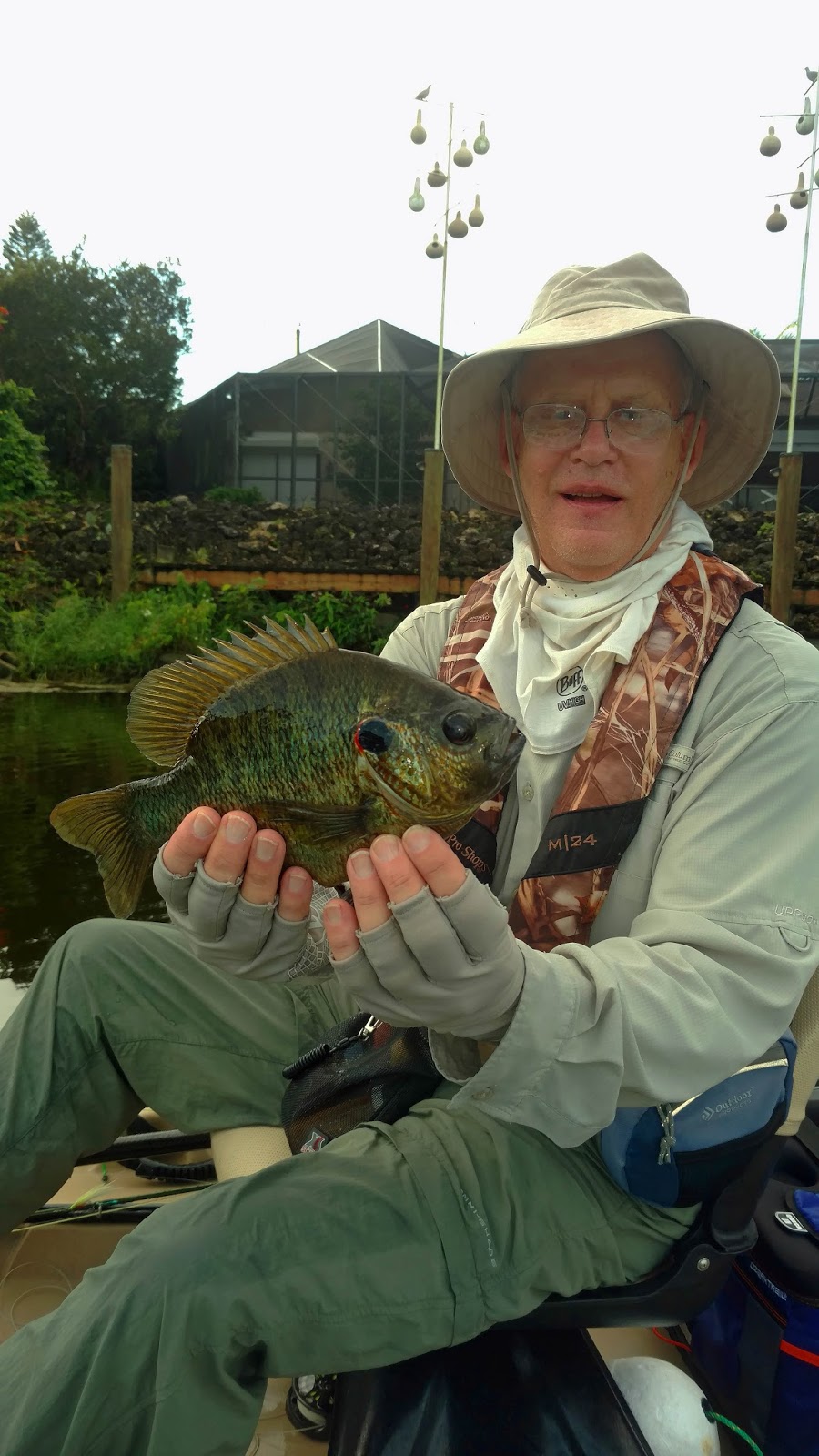
Bluegill are suckers for the Snymph.

That's 39 fish.

Most came on the Snymph.

I have caught bass to nearly 5 pounds on the Snymph. I've caught loads of hand-size bluegill. It's deadly on shellcracker. Speckled perch (black crappie) love it. Ditto for stumpknocker, channel catfish and tilapia.

The best thing about the Snymph is it meets my criteria for a great fly: 1. It catches fish; 2. It can be tied in five steps or less.

Quick, easy, out the door and on the lake. What more can you ask?

It's my opinion that many (most?) flies are designed to hook fly fishermen. They're intricately designed, beautiful and take more time to tie than they're worth.

I received a new fly-fishing/tying magazine to which I subscribe and saw an article written by one of the young guns of fly tying. He wrote about a new fly that he had designed.

Now, nowhere in the article did it chronicle the fly's effectiveness on any particular species. The fellow simply wrote about how to tie it.

It was a good-looking fly, for sure.

But it involved 62 tying steps! That fly would take more than an hour to produce.

The only way I'm going to spend that amount of time on one fly is if fish jump out of the water to hit it or it's a fly that will catch a species that won't hit a fly.

Take a look at the Clouser Deep Minnow, if you will. It's perhaps the best fly in the country for both freshwater and saltwater species. In addition, the Clouser is one of the simplest flies of all. You can crank them out to the tune of 12 or more an hour. Four tying steps and you're ready to fish.

That's my kind of fly. And, by the way, I do use the Clouser successfully in fresh and salt waters.

The Snymph is quite similar in that it's easy to tie and catches fish -- lots of fish.

When the topwater bite is over, I no long head home. I start casting the Snymph. My day is just beginning.