Showing posts with label Florida. Show all posts

Friday, December 2, 2016

Anticipating strong action in fresh and salt waters as we head toward winter

The author shows off a fine peacock bass caught on fly near Naples, Fla. (Photo by John Weimer)
Freshwater fishing has been much better than saltwater fishing.

But that's subject to change any day.

We're moving into the winter pattern and that means several things.

In salt water, it means bluefish, pompano and , hopefully, large snook.

In fresh water, it means wonderful trips to The Everglades for tackle-busting exotics.

We fished the salt a few days in November and did so-so. Fishing Little Sarasota Bay around Vamo, we encountered snook, spotted seatrout, jack crevalle and ladyfish. Snook were plentiful around the islands on the west side of the Intracoastal Waterway and were a blast on topwater plugs.

Trout, although somewhat scarce in most areas, could be found along the ICW. We caught sseatrout to 20 inches on MirrOlure Lil Johns on 1/16-ounce jig heads.

The best action took place around and under docks just south of the launch. Using skip casts to get jigs well under the docks, we caught snook to 30 inches, jack crevalle and mangrove snapper. The most effective bait was the new D.O.A. 2 3/4-inch shrimp in gold flake.

John Lacy of Kentucky joined me for a trip on Little Sarasota and did fair. We caught three snook, two jack crevalle, six spotted seatrout, a mangrove snapper and a ladyfish. We also lost a snook estimated at 15 pounds while skipping D.O.A. Shrimp under docks.

Highlight of the day was the number of manatee we encountered. We probably saw at least 18 manatee over the six-hour outing.

In fresh water, we fished a variety of spots, including Lake Manatee and a small lake east of Naples in southwest Florida.

Lake Manatee, located in Manatee County just 10 miles east of Interstate 75 off State Road 64, is one of my favorite places to fish -- especially during fall and winter. It's a spot where diversity rules and you'll likely catch a variety of fish.

I really don't target any species in particular. I used popping bugs, nymphs and my Myakka Minnow. I catch bluegill, speckled perch, shellcracker, tilapia, stumpknocker, shellcracker, largemouth bass and channel  catfish.

Our best day in November was an outing in which we caught big bluegill, two huge speckled perch (black crappie) and five nice channel catfish. All of the fish were taken on my Snymph (simple nymph).

The following day was much tougher. John Weimer of Sarasota and I combine to catch 26 bluegill, one speckled perch, one bass and a golden shiner on Snymphs.

A few days later, I took John Freyer of Ludington, Mich., and we had to work extremely hard. We combined to land 17 bluegill and a gar. The interesting thing was we couldn't catch anything on Snymphs. Most every fish came on my Myakka Minnow.

John Weimer and I drove 105 miles south on I-75 and had a wonderful outing. Fishing a small lake east of Naples, we caught a variety of fish, including peacock bass to 4 pounds. Interestingly, we had few fish by 1 p.m.

It was at that point, I decided to pull out the 6-weight TFO fly rod and cast an orange-and-chartreuse Clouser Deep Minnow  in areas where I had caught some nice peacock bass. I wasn't disappointed. Over the next two hours, Weimer and I combined to land 23 peacock bass to four pounds. We lost several others.

Peacock bass were introduced in state waters in 1984. Because they can't tolerate cold water, they were stocked only Miami-Dade and Broward county waters. Both barred and butterfly peacocks were stocked, but the bigger barred species couldn't tolerate the cold. Butterfly peacocks thrived.

Somehow, they made their way west to Collier County. And, through a friend, I found out about a small lake and adjoining canal system that holds a good population of these colorful, hard-fighting battlers.

It took me a while before I began catching them with regularity. I found out you don't have to get up too early to catch them. Best action takes place from mid-morning on.

I've caught them on a number of flies (even tiny nymphs), but I've discovered the best action takes place on orange-and-chartreuse Clousers.  I use a fairly quick retrieve.

I also keep my eyes open for peacocks chasing bait or nesting along the shoreline. If you pay attention, you'll be rewarded.

The lake is also home to mega-bluegill, giant shellcracker, monster Mayan cichlid and largemouth bass.

DECEMBER FORECAST: I look for good numbers of spotted seatrout, jack crevalle, ladyfish, bluefish and pompano  in Sarasota Bay over deep grass off Stephens Point and Whale Key. Night fishing for snook should be good around lighted docks. Late in the month, we'll start probing local rivers for monster snook -- especially if we encounter cold weather. In fresh water, Lake Manatee and the Manatee River should yield good numbers of bluegill, channel catfish, largemouth bass, speckled perch and shellcracker. For those interested in non-stop fly-fishing fun, Alligator Alley should yield good numbers of feisty oscar, Mayan cichlid, largemouth bass, bluegill, stumpknocker, warmouth perch and an occasional peacock bass.

I'm booking up fairly fast, so contact me to make sure you get in on the action. You can call me at 941-284-3406 or email steve@kayakfishingsarasota.com.
Happy Holidays!


Steve Gibson
Southern Drawl Kayak Fishing
www.kayakfishingsarasota.com

941-284-3406

Saturday, November 12, 2016

Fast and furious peacock bass action at its best

John Weimer of Sarasota admires a chunky peacock bass he caught on fly.
In the United States, you have to choices when it comes to fly fishing for peacock bass: 1. travel to an exotic destination; 2. visit south Florida.

The author got in on the action, too.
I choose the latter. It's convenient and productive.

A little history here. The state of Florida stocked butterfly peacock bass into south Florida waters in 1984. The original stocking was in waters of Miami-Dade and Broward counties. Waters anywhere north of that area could be too cold in winter for these tropical cichlids.

Somehow the fish have found their way to Florida's west coast and can be found just 100 miles down Interstate 75 from my home in Sarasota. In just 90 minute, my clients and I can be fly fishing for peacock bass.

I will not reveal the name or location of the lake to protect the fishery.

I have fished the location many times in the past four years. At first, peacock bass were somewhat of a mystery. I didn't catch any on my first trip, but a friend of mine did. Joe Mahler, a fly-fishing guru who resides in Fort Myers, caught a chunky 3-pounder on his famous fly, the Straw Boss.

It took several more trips for me to start figuring out how to catch peacocks.

First trick I discovered was to find peacock bass on nests and sight-fish them. I'd stand up in my NuCanoe Pursuit (www.nucanoe.com) and slowly pole along the shoreline. When I'd spot a peacock on a nest, I'd anchor nearby and cast to the fish. Note that peacocks will hit the fly virtually every time it enters the nest. But hooking them is another matter. They have an uncanny ability to spit your fly out quicker than you can react.

So, it becomes a game of guessing and timing. You almost have to "set" the hook before you see the bass take the fly.

I caught some very nice peacocks with this method.

But peacock bass don't spawn year round. So what do you do when they're not on the nests?
I began "blind casting" along the shoreline with No. 6 Clouser Deep Minnows, using a fairly quick retrieve.

For this fish, I use a 5-weight TFO Finesse rod, floating line and 9-foot (8-pound test) leader.
This method has paid the biggest dividends. I've had several "double-digit' days using it.

My best fly is a No. 6 Clouser in orange and chartreuse. I tied it to resemble a baby peacock bass. The fish are cannibalistic and will often eat their young.

Last trip to the lake was very productive.

John Weimer of the Mangrove Coast Fly Fishers and I made the trek and did extremely well. We combined to catch 23 peacocks to 4 pounds. However, we didn't catch our first peacock until 12:30 p.m.

Up to that time, we had nine largemouth bass, one bluegill, one shellcracker and two stumpknocker on poppers and on Gibby's Snymph.

The action was much slower than normal. At that point, I pulled out the 5-weight and set up a drifter along a shoreline that had produced peacock bass in the past. I was quickly rewarded. I caught a trio of peacocks, including a pair of 3-pounders in about 15 minutes.

Meanwhile, Weimer was casting a tiny Clouser that was producing nothing. I gave him an orange-and-chartreuse Clouser and suggested he give it a try. It wasn't long after that he connected on a solid 4-pounder, the largest peacock bass of his life.

We hit several spots, but really found some fast action at a location that has paid off in the past. I was drifting down the bank when I saw a peacock chasing minnows. I made a quick cast and immediately got a hit. I missed that one, but hooked up on a chunky 2-pounder on the next cast.

After I released that peacock, I began casting again. I noticed some action underneath a nearby tree that was hanging over the water and began to cast around it as I neared. I had the rod nearly jerked out of my hand on a ferocious hit. I was solid into another fat peacock.

I caught and released nine peacocks along that stretch. Weimer also caught a fatty.

The day started slowly, but ended beautifully.

"That's why you have to keep at it," said Weimer, who relocated to Florida from his home state of Oregon. "Your days wn't always start out quickly. But if you keep at it and keep a fly in the water you have a chance."

I love fishing south. I love catching fish that I can't find in local waters. I fish south a lot during the year. And it won't be long before I start fishing along Alligator Alley where I target oscar and Mayan cichlid.

These great fisheries are simple too good -- and productive -- for Sunshine State anglers and others to ignore.


Monday, August 29, 2016

NuCanoe's Pursuit and Frontier are simple, comfortable and very fishable

My NuCanoe Pursuit is a fishing machine with clean lines and  loads of comfort.
I have been doing this kayak thing for quite a while now. To give you an idea, when I first started fishing from a kayak, I most often was the only one on the water doing so.

That was in 1986. I fished from a kayak while doing articles for the Sarasota Herald-Tribune on the subject. I used kayaks from Intracoastal Kayaks in Venice and from Economy Tackle in Sarasota.

Client Todd Dawson battles a nice fish out of the Frontier.
I enjoyed it immensely. I love the feeling of freedom and independence that kayaks gave me. I also enjoyed that I could go fishing when I wanted, where I wanted, for which species I wanted and I could fish the way I wanted. I could also fish as long as I wanted and I could leave when I wanted.

As a bonus, I didn't have to stop at a gas station on the way home to fill up the tank for the outboard.

I've been the powerboat route. I had one of the first flats boats in Sarasota, Fla., where I reside. It was a great boat, but it continuously cost me money. If it wasn't one think, it was another.

What I learned many years ago is that I was catching more fish out of the kayak than I did in the powerboat. And that made a whole lot of sense to me. If the fish didn't know I was there, they were easier to catch.
Vinny Caruso fights a shad on fly on the St. Johns River.

Granted, I was limited where I could fish. I was only as good as where  my paddling arms could take me. But I realized that was a bonus, too. If the fish weren't cooperating where I was, I couldn't simply turn the key and speed off to a hot spot 10 miles away.

I was there for the entire time. So, I got to know each and every spot intimately. I eventually discovered every nook and cranny in every spot I fished.

Take Buttonwood Harbor, for example. Buttonwood is a popular spot located on the west side of Sarasota Bay. It's comprised of nine mangrove islands, grass flats, channels and sand holes. It's about a mile long and half mile wide. Within that area, I have about 60 spots I can fish, depending on the wind, season and weather.

Standing and poling the flats at dawn in Charlotte Harbor.
Simply put, fishing from a kayak has made me a better angler.

I co-founded the CCA/Mangrove Coast Fly Fishers annual All-Release Fly Fishing Challenge (along with Capt. Rick Grassett)  in 2004. For the first few years, I fished with a buddy out of his powerboat. Six years ago, I decided it was best for me and my business (www.kayakfishingsarasota.com) that I fish out of my kayak.

I've done well. I have won a division of the tournament nine out of the 11 years. I've won the Snook Division five times and Spotted Seatrout Division four times. On three occasions, I've caught more than enough snook and trout to win both divisions. However, tournament rules limit each anglers to winning just one division.
A.J. Menard fights his first permit.

I've also caught Slams (snook, trout and redfish) three times. My slams haven't been enough, but I've won a division two of the three times.

You might have surmised that I like to fly fish. Yes. And I do it as often as I can.

Early on in my kayak-fishing career, it was a tough go. Most kayaks aren't designed for fly fishing.  There's no place to stow fly rods safely. And most kayaks have plenty of line-snagging equipment and/or accessories scattered over the deck.

Then came NuCanoe. I was introduced to NuCanoe by fly-fishing guru Joe Mahler (www.joemahler.com) of Fort Myers. Mahler is a fly-casting instructor, author, illustrator and world-class fly angler.

A couple of trips with Mahler had me convinced that NuCanoe was the way to go.

When I decided to make the switch, there were just to models: the Classic and Frontier. I opted for three 12-foot Frontiers.  The Frontier is a spacious, wide open kayak that arguably is the most stable watercraft of its kind. Standing in the Frontier is no big deal.

Menard's permit made him smile.
It's so easy, in fact, that I've had anglers as old as 84 standing while fishing.

I have discussed with NuCanoe owner Blake Young that we need to change the designation of the Frontier from kayak to personal fishing craft.

By any name, it's a winner.

About a year after I joined NuCanoe (www.nucanoe.com), the company came out with the Pursuit, a narrower, longer, sleeker version with similar stability. The boat also features four rod tubes in which you can stow four fly rods safely and out of the way.

That sealed the deal for this fly-fished enthusiast!

The Pursuit also has a spacious, uncluttered cockpit. There's nothing for my fly line to catch on.
Simply put, it's a virtual fly-fishing machine.

I'm a minimalist when it comes to rigging and accessories. But that's the beauty with any of the NuCanoe models. The integrated track system allows you to add as many (or as few) accessories as the want.

For me, it's as few. I added an anchor trolley system to my Pursuit. I also mount a GoPro video camera in the track system. That's about it.

I carry tackle in a milk crate behind my seat. I've added seven rod holders to the milk crate.

I fish all over in my Pursuit. I fish saltwater bays and estuaries. I fish freshwater lakes and streams. I fish from Tampa Bay to The Everglades and points beyond.

And best of all, I always catch fish.


I'm a fishing fool in the best fishing kayak on the market.

I'm a versatile guy, so I need the most versatile fishing kayak available.


Tuesday, June 7, 2016

Beach snook seasons looks like it will be a good one

Author Steve Gibson holds a fine snook he sight-fishing in the surf. (Photo by John Weimer)


It's early in the season for beach snook, but I'm going on record that it's going to be a good one.  I've already seen quite a few large snook in the surf and I've done pretty well on them.

If you've fished for a while, then you know what I mean. I seem to have an innate ability to predict the action at a particular spot or during a specific season. Beach snook action has been off somewhat for the last few years. I think that's going to change.

Another nice beach snook on fly.
Beach snook fly fishing might be my favorite activity in local waters. It beats the hell out of blind-casting for undersized spotted seatrout, ladyfish or whatever else might be lurking in the depths. Truth be known, I'd probably rather do to the dentist than blind cast with a fly rod for trout.

That's just me.

I don't think it gets much better than sight-fishing for snook in the clear waters of Florida's west coast. These elusive gamefish usually start showing up in the surf as early as March and will remain there thru September. Peak months July and August.

I like to get to my favorite beach around 7:30 a.m. Realize the sun's not up high enough for you to see much. However, I want to be at my favorite spot or in an area I know there are fish when the visibility is prime.

As the sun rises in the east, your window of visibility gets wider and wider. At 7;30 in the morning, you're luck to see 15 feet up the beach. At 10 a.m., you can see snook 150 up the beach. It's that different.

I try to pick a day when the wind is light from the east. That almost assures that I'll be looking for snook in  a calm and clear surf. It's much easier to see them when conditions are good.
Former Venice resident Scott Dempsey fights a snook on fly.

Now, that doesn't mean they're easy to see. If you're new to the game, seeing snook in the surf can be perplexing and quite frustrating.

Most neophytes look for whole snook complete with tails, scales, fins and eyes. If you look for a complete fish, you'll likely be disappointed and swear there are no snook in the surf.

It's difficult to explain, but I look for a different color. A shape. Movement. There can be a lot going on in the surf, but once you figure things out you won't mistake a snook. In addition to snook, you'll also see mullet, baitfish, whiting, sheepshead, black drum and other species.

Once I spot a snook, I have to determine which way it's swimming or in which direction its facing. If you find a snook cruising north or south just off the dry sand, you've found a fish in what I call the "feeding zone." Fish in that zone (it stretches from the lip of the surf out to four or five feet) are looking for food -- sand fleas, crabs, baitfish. If you've find them there, you've got a decent chance to hook one.

A school of snook in the surf.
You'll also find snook lying on the bottom in the deeper water of the first trough. I suggest casting at those fish, but more often than not they'll ignore your offering. They've already fed and not actively feeding.

Those fish you find lying on the bottom 15-20 feet out usually will be facing to the west. And that offers a casting problem. How do you present the fly without "lining" the fish. Try a curve cast, a cast when execute properly will place the fly in front of the fish without lining them.  The curve casting requires the rod to be horizontal the the water (sidearm). Whip the rod tip at the end of the forward stroke. That whipping will cause the tip to curve the line and fly. Check out this video on the curve cast: https://www.youtube.com/watch?v=TKtmlVMgWPU

When you find a snook cruising in the feeding zone, your first task is to determine in which direction it's swimming. If you're walking north and the fish is swimming south, all you have to do is stop and let the fish come to you. If you're walking north and the fish is swimming north, you'll have to overtake the fish to present the fly properly.

In that situation, I simply move 20 feet away from the water and increase my walking pace enough to overtake the fish. I don't run. i believe snook can "feel" you running and become suspicious.
It's important to present the fly in front of the fish. After all, that's the business end of fish. I've never seen a snook eat with its tail.

Now, the next piece of advice will be questioned by some. But that's OK. It has worked great for me over the years. When casting to a snook in the feeding zone, I make a cast that's perpendicular (straight out) to the beach. I don't make diagonal casts or parallel casts.

I cast straight out and then try to retrieve that fly so that it and snook meet at the same place at the same time.

At that point, one of two things will happen: 1. The snook will ignore (or spook) your offering; 2. The snook will turn and follow.

If the latter happens, then it's up to you to provoke a strike. I do this by speeding up my retrieve or even  wiggling the fly with the rod tip. Realize your fly like is only a foot or two from the dry sand at this point.

And that brings us to fly selection. You should use any fly in which you have confidence. For me, that's my Gibby's D.T. Variation, a fly I've been using for 30 years and one that has resulted in more than 5,000 snook.

Why would I want to use any other pattern?

A little history on the D.T.:

Matt Hoover, a guide in Naples, sent me an original D.T. Special. In an accompanying note, Hooverl wrote: "This is the only fly you'll ever need for beach snook.

He was right.

I've tweaked the pattern over the years to fit my needs. The original D.T. Special featured four splayed white neck feathers on the tail, a palmered white neck collar and the hook shank covered with white thread.

I still use four neck hackles, but I tie them to the rear of the hook facing each other. I also add two strands of pearly flash. I build up the head and tie in a small amount of red thread just in front. I then add eyes and epoxy head and eyes. I leave most of the hook shank bare. Check this out on the D.T. Variation: http://gibbysfishingblog.blogspot.com/2012/06/good-fly-is-easy-to-tie-and-catches.html

I did not come up with the D.T. Special design.

I use fly rods from 5- to 8-weight. It largely depends on where I'm fishing and the size of the fish. Most often, I use my TFO BVK 5 weight with accompanying BVK Reel.

Line choices include a full floating line or a clear, intermediate sinktip. Leave your full sinking lines at home.

To keep things simple, just use a straight piece of 20-fluorocarbon as leader. If you go lighter, make sure you have 12 to 18 inches of 20-pound fluoro for a shock leader (bite tippet).

You'll want to travel light. I carry everything I need in a fanny pack: flies, leader material, leaders, nippers, pliers and water.

Other essential items include cap or hat, sunglasses, cell phone and camera.

I wear neoprene SCUBA boots. I do not advise sandals, Crocs or similar footwear. I also don't recommend flats/wading boots with zippers. Sooner or later, the zippers on your boots with clog up and with sand and shell. And you'll likely break the pull trying to unzip your boots.

I get my zipperless boots at a dive shop in Sarasota.

You might have to take quite a hike to find the fish. You can always camp out in a spot and allow the fish to come to you, but that usually doesn't work very well.

Where to fish? You can find snook in the surf from Anna Maria Island to Naples. That's a lot of real estate. Once you start exploring the surf, you'll find some spots are much better than others.

I try to avoid areas where the beach has been renourished. You'll find that the companies doing this procedure "rebuild" depleted beaches with sand from other areas. And the new sand usually isn't compatible with the original sand. You won't find sand fleas at the edge of the beach in new sand.

And you'll find that even the slightest wave action will "cream" the surf up, ruining your visibility.

My best day fly fishing for snook in the surf? I caught and released 41 snook one morning in 2009. On another outing, Jack Hartman of Sarasota and I combined to catch 51 snook.

My best day in terms of quality fish took place in August 2010 when I caught 15 snook. Eight of those 15 were 28 inches or larger. My largest fish went 40 inches and 20 pounds. On that morning, I also caught and released three oversized redfish and jumped three 100-pound tarpon.

Interestingly enough, I went back the very next morning and caught only two small snook. I didn't see any large snook, redfish or tarpon.

Go figure!

As you've probably figured out, I'm not going to take you by the hand and lead you to the best spots to fly fish for snook in the surf. I've spent too much time finding these prime spots and no one showed me anything.

Start are your favorite beach and branch out from there.

Your success or lack thereof depends on you. If you want to catch a snook you probably will. If you really don't have a great desire, you might want to try blind-casting for seatrout in Sarasota Bay.


Thursday, May 5, 2016

Night fishing around lighted docks was the key to April success

Happy Susan Bostwick of California shows off her first snook. She caught it on a fly rod.
April was a good month, but a perplexing one.

Typically, April is a wonderful time to hit Sarasota Bay and catch a bunch of spotted seatrout. We caught some decent-sized trout during the month, but not a lot of them.

I'm still convinced the bay is still feeling the effects of  last fall's red tide. I could be wrong, but that's my hunch.
Snook often are plentiful in the dock lights.

We did slip out one day and catch some really nice fish. Starting a couple of hours before daylight, we caught a couple of snook and jack crevalle around dock lights in the Longboat Key rim canal. 

After the sun came up, we paddled out into the bay and found cooperative trout in several spots. But when we hit the "outer elbow" off Whale Key, we started getting trout from 2 1/2 to 4 pounds. Must have caught 15 before they quit hitting.

We caught all of the trout on MirrOlure MirrOdines, a suspending plug that is seemingly magical on a variety of species. Key to success with the MirrOdine is working it correctly.

I like to hold the rod horizontal to the water to my left. I twitch the lure a couple of times, then reel up the slack. I repeat this retrieve until I'm ready to make another cast. Most often, fish will hit as the lure is suspending.
Lee Soares of California battles a leaping seatrout.

It's important to work the lure slowly and allow it to perform its magic.

In addition to trout, I've also caught ladyfish, jack crevalle, snook, mangrove snapper, bluefish, Spanish mackerel and redfish on the MirrOdine. I don't think there's a fish out there that won't hit it!


Vinny Caruso of Bradenton and Capt. Bob Zola of Fort Lauderdale joined me to explore the waters off Vamo in Little Sarasota Bay. We caught 15 trout to 24 inches, several ladyfish, three snook and a flounder. We caught the fish on MirrOdines and MirrOlure Lil Johns on light jigs.

Howard Beemer of Fort Myers and his son in law, James Wies of Illinois fished Little Sarasota Bay and caught 10 trout to 23 inches, ladyfish, snook and flounder on MirrOdines and Lil Johns.
Mike Skalla holds a decent black drum.
Mark Skalla and Mike Skalla hit the water an hour before daylight and had a fair day. Mark caught a couple of nice snook on jigs while fishing dock lights around Longboat Key. They also caught three black drum to 10 pounds, two jack crevalle, mangrove snapper, spotted seatrout and flounder.

Vince O'Boyle of Venice caught flounder, redfish, mangrove snapper and a black drum on Lil Johns and light jigs in the rim canal at Longboat Key.

Ted Tolliver of Ohio had a fair day. He managed a dozen trout to 17 inches, Spanish mackerel, ladyfish and bluefish. We fished the Longboat Key rim canal and deep grass in Sarasota Bay off Whale Key. Most of the fish were taken on Lil Johns and MirrOdines.

Lee Soares and Susan Bostwick of Petaluma , Calif., fly fished on a tough day, but their persistence paid off. Each caught his/her first snook. Lee's 28-incher was the day's best. They fished lighted docks in Bowles Creek.

Mark Skalla's first snook.
After daylight, we moved out to deep grass patches in Sarasota Bay. They caught spotted seatrout to 23 inches.

The significance of their outing was that a day prior, 21 anglers fished the Fly Division of the Sarasota CCA's Photo All-Release tournament. Those 21 angler caught a total of four trout and one redfish.

Lee's best snook and trout would have made him grand champion of the Fly Division in that tournament.

Pat and Penny Martin of New York joined me for a four-hour outing. We launched at Buttonwood Harbor and fished the rim canal at Longboat Key. The morning was very slow. We caught flounder, jack crevalle, ladyfish and missed a couple of snook.  We estimated one of the snook at 20 pounds or more.

Everette Howell of Longboat Key hooked a pair of tarpon and a snook while fly fishing around lighted docks. After daylight, he switched to a MirrOlure Lil John on a light jig and landed a 25-inch snook.  We caught one other snook and a jack crevalle.

Greg Tango of New Jersey and Mike Tango of California caught four snook to 27 inches, mangrove snapper, jack crevalle, flounder, silver trout and 20 spotted seatrout to 21 inches fishing around dock and seawall at Stephens Point and deep grass patches in Sarasota Bay. They used MirrOlure Lil Johns on light jigs, MirrOdines and D.O.A. Deadly Combinations.

We fished Lake Manatee on a couple of occasions and did fair. Launching at the Verna-Bethany Bridge at the east end of the lake, we caught largemouth bass to 3 pounds and hand-sized bluegill on popping bugs. We moved up the river and caught bluegill, bass and stumpknocker on nymphs.

We launched at Lake Manatee Fish Camp on another occasion and caught six bass to 3 pounds on poppers. We also caught bass, bluegill and channel catfish on nymphs.

I drove down to Casey Key and spent a morning looking for snook in the surf. It's still a little early, but the snook population in the surf will increase daily. I saw about 10 snook, but didn't catch any.

MAY FORECAST: Snook and tarpon are the best bets on fly rod around lighted docks along the east and west sides of Sarasota Bay. Spotted seatrout, ladyfish, jack crevalle and a few bluefish should cooperate over deep grass on both sides of the bay. Snook numbers should increase in the surf for those who like to sight-fishing with fly rod or spin tackle. In fresh water, I anticipate good action on bluegill, largemouth bass and channel catfish.

May is a great time to fish Sarasota Bay and surrounding waters. In addition, I look for decent action on peacock bass, Mayan cichlid, bluegill and shellcracker in south Florida waters.
I anticipate vastly improved sight-fishing for snook in the surf.

Fishing from a kayak is one of the world's great activities. I've been doing it since 1986.
If you'd like to fish, please give me a call!


Steve Gibson
Southern Drawl Kayak Fishing
www.kayakfishingsarasota.com

941-284-3406


Thursday, March 31, 2016

March resulted in great action for spotted seatrout

Drei Stroman of Fort Myers battles a feisty Palma Sola Bay pompano on fly rod.
How good has the fishing for spotted seatrout been?

Well, I set my goal for the year at 500 seatrout on fly. I've now totaled more than 500 trout (514 to be exact).  Guess I'll have to adjust that goal!

This fly-rod pompano put a big smile on Stroman's face.
But that illustrates just how good the seatrout fishing has been. We've done well on virtually every trip.

Palma Sola Bay has been the hot spot -- as it usually is this time of year. Fish drop into channels and sand holes during colder weather where they're easy targets for fly anglers and spin fishers alike.
During March, we averaged 42 trout per trip. And that included a 10-trout day in Sarasota Bay. On two occasions this year, I caught and released more than 100 trout in a day.

These fish have run the gamut of sizes. We caught plenty of them less than the minimum size limit (15 inches), but also have caught them up to 23 inches. Biggest trout of the month was a 25-incher that I caught in Little Sarasota Bay off Vamo. I found a bunch of trout over deep grass in that area.
John Weimer of Sarasota joined me for an outing on Palma Sola Bay and had a good time. We combined to catch and release 50 trout to 21 inches on Super Hair Clousers and Popovics Jiggy flies. In addition, we caught loads of ladyfish and a couple of sugar trout.
Jay Karol of New York struggles to subdue a pompano.

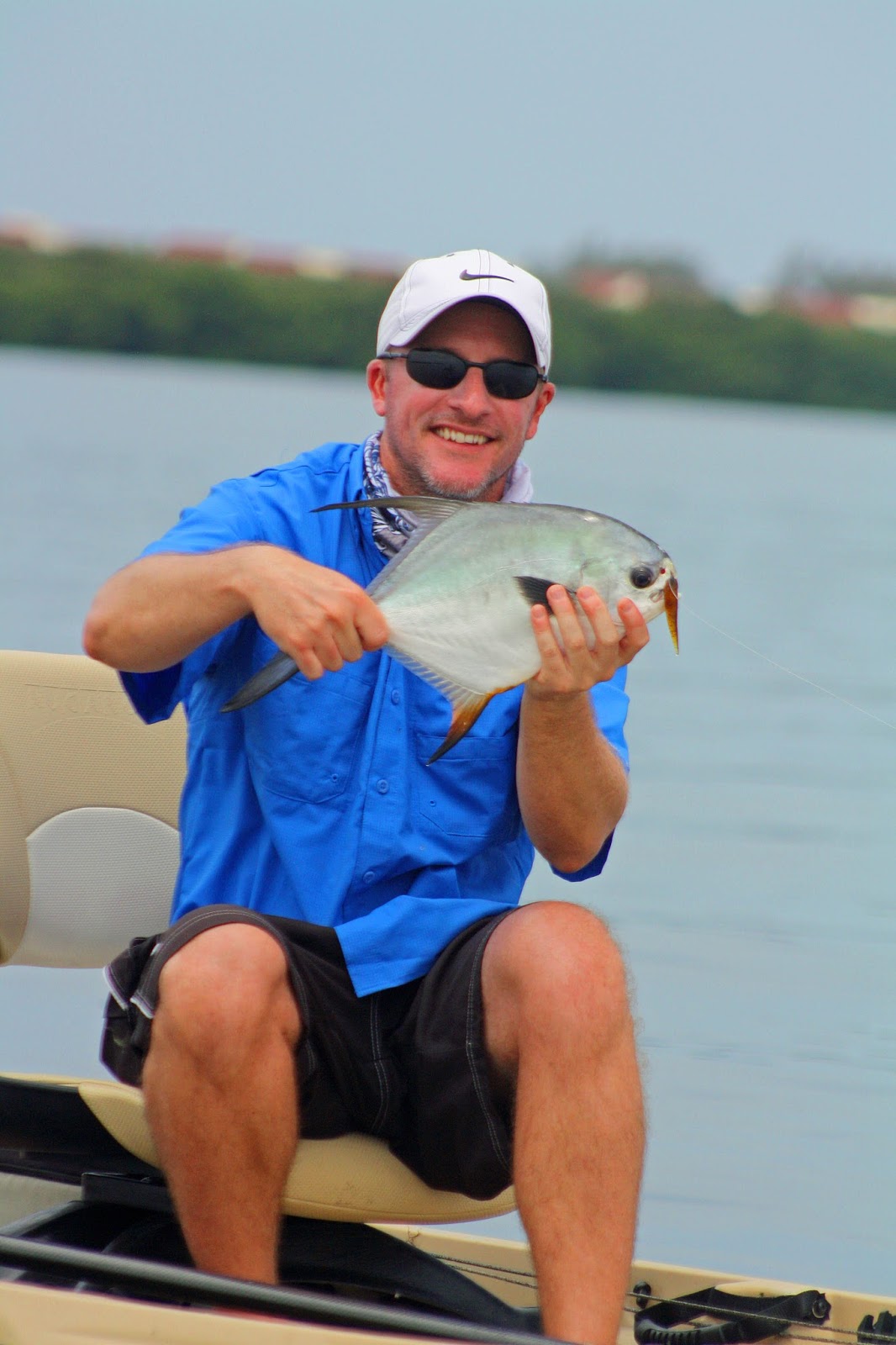
Drei Stroman and Katrina Hillard of Fort Myers joined me on Palma Sola Bay and had a good outing. We landed more than 50 trout, plus ladyfish, five sugar trout and a feisty pompano.

On a solo trip to Palma Sola, I caught 27 trout on Clousers and Jiggies, plus two sugar trout.
I fished Sarasota Bay for the first time since Nov. 6 and had a slow outing. I caught six trout and a few ladyfish out in the bay. I added another dozen trout from the basin near the launch. Largest fish was 16 inches.

We also did quite a bit of freshwater fishing at Lake Manatee during the month. Most trips were very good, but a couple were slow.

First outing resulted in 20 hand-sized copperheaded bluegill, six speckled perch and a half-dozen largemouth bass on No. 12 nymphs under a strike indicator.

The author with his largest tilapia on fly.
Denton Kent of Sarasota and I combined to land 15 bluegill, one bass and three specks on popers and nymphs. We fished hard on this outing, but found the going a little slow.

The next day saw improved action when John Weimer accompanied me. We caught 25 big bluegill, a bass, seven speckled perch and a 4-pound tilapia. It was the largest tilapia I've ever caught on fly rod. Most of the fish came on nymphs under a strike indicator.

On a solo outing a few days late, I caught 10 bluegill, seven speckled perch and four bass on nymphs. The specks were spawning in shallow water. if you caught one, you could expect more from that area.
John Kis and Jay Karol of New York had a good day in Palma Sola Bay. They totaled 50 trout to 19 inches, loads of ladyfish, a pompano, sugar trout, three Spanish mackerel to 5 pounds and a flounder. 

Most of the fish were caught on VuDu Shrimp. I also caught fish on a MirrOlure MirrOdine mini.

Majestic visitor on a Palma Sola Bay outing.
Ken Babineau, president of the Mangrove Coast Fly Fishers, joined me for a trip to Lake Manatee. Despite low wind and overcast, we struggled to land only five bluegill and one bass. it was the slowed day I've experienced on Lake Manatee in years.

I fished Little Sarasota Bay around Vamo and caught 19 trout to 5 pounds, a 25-inch snook, flounder, jack crevalle and loads of big ladyfish on MirreOlure Lil Johns, topwater plugs and MirrOlure Mini MirrOdines.

The month was on the windy side. I'm hoping the wind calms down just a little for April!

APRIL FORECAST: I anticipate continue strong spotted seatrout action over deep grass. Night snook should come on strong around lighted docks. There also could be some decent tarpon action around docks, too!  Redfish are anyone's guess (as always). In fresh water, I look for bluegill, speckled perch, largemouth bass and channel catfish in Lake Manatee and the Manatee River.
Bookings are coming in for April, so available days are getting fewer. Give me a call (941-284-3406) or email me (steve@kayakfishingsarasota) to make sure you get the day(s) you want.


Steve Gibson
Southern Drawl Kayak Fishing
www.kayakfishingsarasota.com

941-284-3406


Saturday, August 1, 2015

Night fishing produced snook, tarpon, seatrout and beat the July heat

If July wasn't the hottest month I've experienced in Florida, it certainly had to be among the warmest.

Snook hang out around dock lights and often are easy fly-rod targets.
With that in mind, we switched gears a little and got out on many occasions a couple of hours before sunrise in order to avoid the heat and get in on some fine fly fishing.

We've got launches on both sides of Sarasota Bay near lighted docks. That's where snook, tarpon, spotted seatrout, lookdown and occasionally redfish like to hang out.

Dock lights attract small baitfish and shrimp. Those critters attract predator fish.

For this type of fishing, I've found the best action usually takes place on the stronger outgoing tides. If that's not possible, then I'm satisfied as long as the tide is moving decently.

I take a couple of 7- or 8-weight fly rods, loaded with full floating lines and 9- to 10-foot fluorocarbon leaders (20-pound test). My fly of choice is my Gibby's Snook Shrimp, a pattern that has proven to be very effective for night action.

One of the neat things about fishing from a kayak is that you can get pretty close to the fish. That, in effect, eliminates the need for long casts.

When I get to a dock that I want to fish, I'll figure out which way I'm going to drift and position the kayak. I prefer my kayak to drift with the bow pointing toward the target.

I recently obtained my first NuCanoe Pursuit, a kayak that perfectly suited for night fly fishing. The cockpit is open and uncluttered. In addition, the Pursuit drifts true and isn't affected by wind as much as other brands of kayaks.

As I'm getting ready to fish, I'll pull 10-12 strips of line off the reel, placing them in the cockpit in front of my feet. That's plenty of line if you position your kayak no more than 20-25 feet from your target.

When I'm drifting, I place the paddle across my lap. That makes it easy to make a bow adjustment if needed. I can simply dip the left or right blade in the water to fine tune my bow.

With only 20 feet or line out and being so close to my target, false casting is virtually eliminated. All I have to do is pick my line up on the back cast and lay it down on the forward. I see too many anglers false casting four, five and six times.

The speed of retrieve varies. I've found the best technique is to simply let the fish tell you. Begin with  medium speed and adjust accordingly.

Another key is to watch your fly. Sometimes, snook, tarpon and other species will follow it almost to the kayak. I've had fish take the fly within five feet of the boat. I've seen anglers lift their fly from the water to make another cast while a fish was frantically trying to eat it!

Most lights -- whether above or below the water -- light up the area in a circle. While you'll see many fish in the light, it's not wise to cast right in the middle. I begin by working the edges and into the shadow line. You can work your way toward the middle as you go. If you chance a cast to the middle early on, you risk spooking a majority of the fish.

It's good if you have multiple docks. When you hook a fish or the action slows, you can move to another. You can always return to a hot dock. Things usually will return to normal in about 10 minutes.

The biggest problem I've found is keeping a determined snook from taking you under a dock or around pilings. When I hook a fish, the first thing I do is try to prevent it from running under the dock or around a piling. And, if I'm able, I will hold the rod with one hand and paddle backwards away from the structure. I'm way ahead of the game if I can get the fish out into open water.

I've perfected a method of one-handed paddling. It takes some getting used to, but is very helpful in these situations. I'll usually hold the rod in my right hand and paddle with my left. The method consists of putting the paddle shaft through a triangle created by placing my right elbow on my right knee.  It takes practice, but it works beautifully.

We've done pretty well on tarpon this summer. These are smaller fish, averaging about 10-12 pounds. They put on quite an aerial show. Luckily, tarpon prefer to do their battle away from the docks.
Snook are another matter. Their first move usually is to get back under the dock or around pilings.

You've got to prevent them from doing so if you don't want to lose your fly or leader. Put the pressure on them! What do you have to lose?

I've been successful in landing snook to slightly more than 30 inches. I've seen snook which I'd estimate at 35 inches or longer.

A fly-fishing Super Slam (snook, tarpon, seatrout, redfish) is possible. It's pretty rare, but can be done. It's fairly common to get the snook, tarpon and seatrout around the docks. On occasion we'll get reds in the dock lights, too. I've had a couple of clients fall one species short this year.

Most often, however, you'll have to get one or more species after the sun comes up. I'll usually paddle to nearby flats.

I got a Super Slam on a recent trip, but my redfish and trout came on spinning tackle.

I spent a few days in July fishing local fresh water. I fished Lake Manatee one day and did fair. I caught and released several bluegill and one hefty channel catfish on my Myakka Minnow.

I also fished Webb Lake south of Punta Gorda and caught a number of bedding bluegill on Myakka Minnows.

Pro fly-fisher Joe Mahler of Fort Myers joined my for a day on the Manatee River. Our goal was to target channel catfish on fly. It was slow, but we each landed channel cats.

Matt Sheffer of Muskegon, Mich., and his son, Noel, joined me for a morning off Stephens Point in Sarasota Bay. They were in town for the annual AAU National Baseball Tournament. The action was fair and we caught spotted seatrout, ladyfish, mangrove snapper, flounder and a snook on D.O.A. CAL Jigs with paddle tails, MirrOlure MirrOdines and D.O.A. Deadly Combinations.

I spent three days in Orlando at ICAST, the sportfishing industry's annual trade show. I worked the NuCanoe booth. NuCanoe was showing its newest kayak -- the Pursuit. It's a great fishing kayak and especially a great platform for fly fishing. Check it out at http://www.nucanoe.com/pursuit-fishing-kayak/.

I expect August to be a carbon copy of July. One difference, however, is we'll find schools of redfish on the flats. They school up in late summer in preparation for their  spawning run into the Gulf of Mexico. If you can find a school, you're almost guaranteed a hookup! Trout action will be fair over the deeper grass, along with ladyfish, jack crevalle and mangrove snapper. The best action be snook and tarpon around lighted docks at night. Of course, beach snook fishing is expected to be good was the weather settles and we get easterly wind.

If you want to book a trip or have any questions, please call me at 941-284-3406 or email me at steve@kayakfishingsarasota.com.


Steve Gibson
Southern Drawl Kayak Fishing
www.kayakfishingsarasota.com

941-284-3406


Saturday, June 28, 2014

June saw improved action around region's fresh and salt waters

Small Tampa Bay sharks are thrilling, fun and perfect for kayak anglers.
June saw improved action for Southern Drawl Kayak Fishing.

Best fishing took place in southern Tampa Bay where we encountered a variety of species, including snook, spotted seatrout, flounder, jack crevalle, cobia and shark.

Kay Semrod of Sarasota battles a pompano.
Last year, we began shark fishing in Tampa Bay at Fort DeSoto. We tried southern Tampa Bay near Joe Island this month and found slightly larger shark.

At first, I wasn't sure I would offer shark trips for several reasons, mainly kayak stability problems. 

However, after switching to NuCanoe a couple of months ago, stability is no longer problem. The NuCanoe Frontier 12 is perhaps the most stable hybrid fishing kayak available.

With that in mind, we will offer shark trips for those interested.

What I've found out so far is when we fish around Joe Bay, a variety of fish is readily available. I usually begin casting artificial lures for redfish, snook and trout at dawn. I've hooked snook in excess of 20 pounds in that area.

After a couple of hours, I switch to shark out in front of Joe Island. I've found a small, deep channel that holds good numbers of shark. For shark fishing, I use a conventional reel, Star Rod, 30-pound braided line, wire leader and 9/0 circle hook. I use jack crevalle, ladyfish, grunt or pinfish for bait.

I anchor the kayak, then put the bait out 20 or 30 feet from the kayak. It usually doesn't take long for a shark to home in on the scent and take the bait.

When that happens, I remove the rod from the holder, turn the clicker off, put the reel in gear and hold on. There's no need to set the hook when using a circle hook. Pressure it all it takes. If you set the hook, you're really defeating the purpose and probably won't hook up. Circle hooks usually assure a firm hook-up in the corner of the shark's mouth.

Once a shark is hooked up, we release the anchor and "go for a sleigh ride."

Mind you, I'm not targeting large sharks. For the most part, we're hooking 30 to 80-pound blacktip and other small species.

On two trips, we encountered schools of overslot redfish. These big breeder reds are in excess of 30 inches and will hit most anything cast their way. We caught several fish on topwater plugs.

That's where the NuCanoe Frontier comes in. Because of its stability and superior comfort, we're able to stand for long periods of times -- and that's a must when trying to spot schools of redfish. Often, the only clue to the redfish is a slight color change in the water. You could never see the color change sitting down.

Trout fishing has been very good over deep grass in Tampa Bay. We've been catching trout to 4 pounds on MirrOlure MirrOdines, D.O.A. Shrimp and MirrOlure Lil Johns on light jigs.

Closer to home, Sarasota Bay has been producing fair trout and redfish action. In addition, we've been picking up a few jack crevalle, bluefish and pompano.

Kay Semrod of Sarasota fished with me in Sarasota Bay and caught pompano and ladyfish on MirrOdines off Stephens Point.

If you're interested in sight-fishing for snook in the surf on fly rod, the action has been poor to date. That could change any day. We spent a day walking Manasota Key and another along Casey Key and saw few fish.

In fresh water, we fished Lake Manatee, the Manatee River, Shell Creek and Webb Lake with mixed results. We took good numbers of large bluegill, largemouth bass, stumpknocker, channel catfish and tilapia on nymphs, popping bugs, worm flies and Myakka Minnows.

July forecast: We look for improved beach snook action as the fish go into post-spawn mode. Shark action should continue good in southern Tampa Bay. We also look for good redfish, snook and spotted seatrout in Tampa Bay. Closer to home, spotted seatrout and redfish should be the best bets in Sarasota bay. Night snook fishing should be good around lighted docks on the outgoing tide. It's hot in Florida in July, so a night snook trip is a good way to beat the heat. We love to combine a day/night trip by starting two or three hours before dawn around lighted docks and then heading out into the bay to get the early bite and first light.

I can't wait for you to try the NuCanoe Frontier, the best fishing kayak that I've experienced. In addition to superior stability, the Frontier's 360-degree seat offers superb comfort.

As always, I'd like to thank my sponsors: NuCanoe, D.O.A. Lures, MirrOlure, Aqua-Bound Paddles, Temple Fork Outfitters and Peak Fishing.

Please feel free to call me or email me to book a trip and discuss possibilities.


Thank you,


Steve Gibson
Southern Drawl Kayak Fishing
www.kayakfishingsarasota.com
@gibby3474 on Twitter
www.http://gibbysfishingblog.blogspot.com/

941-284-3406


Friday, June 13, 2014

New stable NuCanoe Frontier 12 doesn't disappoint


Most of you are aware that I recently switched to the NuCanoe Frontier 12.
Stability is a NuCanoe feature.

I've had the opportunity to fish out of this kayak for the last month and I'm very impressed.

I tested the NuCanoe (www.nucanoe.com)  prior to my purchase.

My first experience came last year when Joe Mahler, a Fort Myers' fly-fishing guru invited me to fish Webb Lake, a body of water in the Babcock Webb Wildlife Management area east of Punta Gorda in Charlotte County.

Mahler, a NuCanoe Pro Staffer,  didn't brag about the vessel. He didn't really say anything. He just let me paddle it and fly fish from it.

Sold.

The NuCanoe Frontier 12 is everything I've ever wanted in a fishing kayak -- and more.

Because of their width, the NuCanoes wouldn't fit properly on my small trailer. So, I held off making the switch.

However, last February I had to buy a new trailer. And this one was wider and larger than the first. It was perfect for the NuCanoe. But I still had to hold off because my kayaks were less than a year old.

In May, I had spent a morning on the Braden River, fly fishing for bass and bluegill. On the way home, I stopped at a convenience store for a soft drink. I wasn't in the store more than five minutes, but when I came out my kayak was gone.

I needed a kayak. And I needed it quick. The proverbial lightbulb in my head brightened. It was a message that was almost heaven-sent. Time to order the NuCanoes.

I contacted Blake Young at NuCanoe and ordered three Frontier 12s and a few accessories.

These kayaks are made for fishing (especially fly fishing). There spacious decks are unencumbered and handle fly line exceptionally well. There is little for fly line to hang up on. If you fly fish, then you know the fly line will catch or hang up on anything it can.

The boats are so stable that you can literally stand up and tap dance. I stand quite often and do so when fly casting. They're 41 inches wide, so you can imagine the stability.

Stability is a key issue for a guide. You can't have clients flipping when you're out in salt or fresh water. I had three clients flip in my previous kayaks. One did so while anchored. One flipped while paddling. The other flipped while fishing.

And the biggest factor was that I flipped my kayak in a 10-foot canal in winter when the seat came loose from its mount.

Not good.

I have never allowed clients to stand because of liability issues. I'll probably keep that policy, but I feel confident no one will flip a NuCanoe.

I guess some might say that they're a tad slower than other fishing kayaks out there. I don't know, but I will tell you that the difference is miniscule. Say you sustain a speed of 3.5 miles per hour in another brand of fishing kayak. I imagine you can do about the same in a NuCanoe.  If it's slower, we're talking 10ths of a mile per hour.

If paddling isn't your game, you can add an electric motor or even a small outboard to the NuCanoe. The stern is strong and square. That could come in hand for trips to such destinations as Flamingo or the Florida Keys.

The NuCanoe seat that I use is the best I've ever encountered. The Max 360 seats are cushioned, elevated and swivel 360 degrees.  And you really can turn all the way around because of the stability of the kayak.

On a recent trek to the Florida Everglades, I asked a buddy to go. The only catch was that he had to fish out of one of my Frontiers. He's a Pro Staffer for another kayak manufacturer.

When the trip was over, he announced he was going to sell his kayak and buy a NuCanoe.

"It was the most stable kayak I've ever been in," he said. "And the stability was impressive.

"I didn't notice any drop-off in paddle speed."

NuCanoe is headquartered in Bellingham, Wash.  They're not as popular as some other brands, but that's because you and your friends haven't fished out of them -- yet. If you do, there's a good chance you'll add a NuCanoe to your fleet.

NuCanoe is a relatively new player in the fishing kayak game, but that will change. Young and Mahler are collaborating on assembling a Pro Staff around the country to give the boats more visibility.

I've always found that getting clients in your kayaks is the best advertising. The NuCanoe Frontier will sell itself.

I started kayak fishing in 1987 -- long before the current trend. Back then, you could head out and never encounter another kayak. The sport's popularity has grown immensely since then.

I didn't add much to my boats. All I did was add an anchor trolley to each. I didn't want to make the boat cumbersome with all sorts of bells, whistles and gadgets.

At 80 pounds, the Frontier 12 is somewhat heavier than other similar kayaks. However, all you have to do is purchase a Transport Cart and your problems are over. The cart attaches to the stern and you can then pick up the bow and roll your kayak to wherever you want -- effortlessly.

The cart also makes loading the kayak on top of a car or SUV a cinch. Loading the kayak into the bed of a pickup truck no big deal.

In short, the cart makes loading and unloading a one-person operation.
I strongly suggest a Transport Cart.

You can lighten the kayak by six pounds by simply removing the seat.

You really can stand in a Frontier with no problem. Now, I have stood in other kayaks and I can tell you they're "tipsy." There is NO sense of tipsiness in the Frontier. It is the most stable fishing kayak on the marker -- bar none.

Another  thing that I like about the Frontier is that with the elevated seat, there is plenty of room under it for a tackle box, dry box or whatever you chose.

I carry most of my plastic tackle boxes in a milk crate that I place directly behind the seat. I have six rod holders attached to the crate. Used to be I had to reach blindly behind me to grab a tackle box or rod.

No longer.

I can just turn in the Max 360 seat and get what I want.

That's a really big deal.

I do advocate a long paddle because of the Frontier's 41-inch beam. According to NuCanoe's Blake Young, a 275-cm paddle works best. I have used a 250-cm paddle with no problem.

When standing and poling my Frontier, I employ a 9 1/2-foot carbon-fiber pole. I find this works a little better than a paddle.

As you can tell, I'm a big proponent of NuCanoe -- especially the Frontier 12. I will be assisting NuCanoe at ICAST in Orlando on July 17-18. I am looking forward to it.

ICAST will be held in Orlando's Orange County Convention Center.

ICAST stands for International Convention of Allied Sportfishing Trades. It's the world's largest sportfishing trade show.

I'll be the fellow in the NuCanoe booth with the big smile on his face!