Tuesday, June 30, 2015

Tarpon, snook and shark topped the list for June

This hefty blacktip shark ate a 1 1/2-pound live jack crevalle in southern Tampa Bay.
One word describes June around Sarasota: hot.

The fishing wasn't pretty close to hot, too.

We caught a variety of fish during the month, although we concentrated on tarpon and snook.

Jack Littleton's first fly-rod tarpon.
Fly angler Jack Littleton of western New York jumped three tarpon and landed one while fishing at night around lighted docks in Bowles Creek. It was Littleton's first tarpon. He also hooked a snook, but broke it off. There were plenty of fish around the lights, but the bite was off.

The next day, we moved to Manasota Key where our goal was to sight-fish snook (and other species) in the surf. Conditions were good and snook were somewhat plentiful.

Littleton hooked a monster snook early on, but lost it after about a minute. The fish was lying in a foot of water and took a Gibby's DT Variation. After the hookup, the big snook (we estimated it at 20-25 pounds) took off on a long, fast run.

"I've never felt a fish that fast and powerful," said Littleton. "I'm not sure what happened?"

Getting out early is a good way to beat the heat.
Rest assured, it was nothing that Littleton, an accomplished fly fisher, did.

Later in the day, Littleton hooked another snook and landed it. Although it was significantly smaller, it was the first snook of his impressive fly-fishing career.

Beach fly fishing has been fair. I made a number of trips during the month to Manasota Key and Casey Key.  My totals ranged from zero fish to 11. I saw an average of 100 snook per trip. Most of the snook were in the 20-24-inch range.

This action should only get better, with the peak month being August.

Jack Littleton hooked up to a monster snook.
Sight-fishing snook in the surf is one of my favorite ways to fish. If you let your mind wander, you can envision yourself on a remote Bahamian island.

In addition to snook, we encounter spotted seatrout, redfish, houndfish, mangrove snapper, flounder , Spanish mackerel and even tarpon on these trips.

If you're interested in fly fishing the beaches, here's what you'll need:

1. Cap or hat

2. Sunscreen

3. Polarized sunglasses

4. Proper footwear

I wear dive boots that I purchased at a local SCUBA shop. I like them because they slip on and off , have thick soles and are comfortable. I do not like flats/wading boots that have zippers. The zippers are usually rendered useless by sand and shell.

Sandals and tennis shoes are not good choices for beach snook fishing. The attract sand and shells.

Why should you fish with me? Couldn't you simply head out to the beach and fish by yourself?

Sure, you can. However, I know where the fish are at all times.

In addition, you'll probably have a tough time seeing the fish. I see them pretty darn good.

Bay fishing has been fair. We've been fishing mainly in southern Tampa Bay around Joe Island.

Tate Anderson of Sarasota and his girlfriend, Michelle, joined my for a Tampa Bay outing and we did fair. We totaled 40 spotted seatrout to 17 inches on MirrOlure MirrOdines.

I fished solo in the same area a couple of weeks later and did a little better. I caught and released six snook and a half dozen spotted seatrout on Zara Super Spook Jrs.  I also released a 5-foot blacktip shark  that I caught on a conventional rod and reel loaded with 30-pound braid, 60-pound wire leader and 9/0 circle hook. I used a 1 1/2-pound jack crevalle for bait.

Tampa Bay is among  the world's top shark fisheries. Common species are blacktip, bull, bonnethead, lemon, tiger and hammerhead.

We also fish around Fort DeSoto when we're targeting shark.

JULY FORECAST:  Beach snook fishing should improve as baitfish moves into the surf. We should not only see more snook, but larger snook. Night fly fishing should continue strong for snook, tarpon and spotted seatrout. In Tampa Bay, shark fishing will  be hot. In addition, snook, redfish, spotted seatrout, flounder and jack crevalle should please. In Sarasota Bay, I look for decent action on spotted seatrout, redfish, ladyfish and jack crevalle.

Yes, it's hot in Florida during the summer. However, we get out early or fish before daylight, so it's really not too bad at all.

If you're interested in getting in on some of this action, please give me a call (941-284-3406) or email me (steve@kayakfishingsarasota.com).


Steve Gibson
Southern Drawl Kayak Fishing
www.kayakfishingsarasota.com
941-284-3406


Thursday, June 11, 2015

Now is the time to sight-fishing snook in the surf

A sizable school of snook swims in the surf along Casey Key south of Sarasota.
I have conducted seminars on fly fishing for snook for the past 30 years.

In almost every session, a majority of folks that I talk to have yet to catch their first snook on fly.
I live in Sarasota, Fla., on the Gulf Coast. The area offers some great sight-fishing for snook from May through August. We walk the local beaches and fly fish snook in the calm, clear surf.

The author shows off a fine beach snook.
Sight-fishing, for those who aren't familiar with the activity, is spotting the fish before making a cast.  It's considered the ultimate activity for many fly anglers.

We slowly walk along local beaches and look into the surf. When we spot a snook, we'll present it a fly. There are times when we'll see 300-400 snook in a morning.

This activity isn't beyond the skill level of most anglers. If you have the desire to sight-fish a snook, you can do it. All you need is a quality pair of polarized sunglasses, hat or cap and the ability to cast a fly.

It's that simple.

And if you can follow a few simple directions, you're on your way.

Prime months are June, July and August. If I had to pick my peak times, it would be mid-July to mid-August. That seems to be the time when the most snook are in the surf.
Scott Dempsey of Savannah, Ga., succeeded.

Snook take to the surf as early as March. It all depends on the water temperature. When it hits 75 degrees, snook will move from the bays through the passes and spread out along the beaches. You can find them along Florida's west coast from Anna Maria Island to Marco Island.

While you might find them at any beach, realize there are some better than others. That's where I come it. I have spent a lot of time walking the beaches, so I know which are holding fish and which aren't.

I don't like to waste my time.

What I look for is good weather conditions. I like a bright, sunshiny day with a gently easterly breeze. 
This usually results in a fairly calm surf with clear water. And that's what you need when you're trying to sight-fish.

A "healthy" snook forages in the feeding zone.
When you're looking for snook, don't make the mistake of trying to look for a whole fish with eyes, mouth, fins and tail. If you do, you probably won't see very much. What you're looking for is movement, a shape, a shadow or even just a fin.

It's much like sitting in a tree stand, looking for deer. If you look for a whole deer complete with antlers, head, nose, mouth, body, four legs and a tail, you'll likely fail. When you're deer hunting, you might see just an ear twitch. Or the subtle movement of a tail.

Once you spot your first snook, it becomes pretty easy.

Where do you look? Well, the surf is an arbitrary thing that can be pretty large. I divide it into two pieces: the feeding zone and the trough.

Gibby's DT Variation is the fly of choice.
The feeding zone is that area from the dry sand out to four feet. Snook will cruise parallel to the beach in this zone looking for food.

You'll often find them in the trough (that deep area just off the beach) lying on the bottom and facing west. These fish usually aren't hungry and tough to fool.

I usually arrive at the beach about 8 a.m. Doesn't do much good to get there any earlier because the sun won't be high enough in the sky to light up the water. Your "window of visibility" will be very small early and it will open wider as the sun rises. By 10 a.m., you'll be able to spot a snook 150 feet away.

When you spot a snook, first determine in which direction the fish is swimming. If it's coming toward you, all you have to do is stand still and wait for it to come into range. If it's swimming away from you, you'll have to get in front of the fish in order to make a cast.

What's the proper cast? For me, it's a perpendicular cast (straight out from the beach). I like to time my retrieve so that the fly and fish meet at the same spot at the same time. When this happens, two things can happen. The fish will begin to track your fly or it will ignore it.

If the fish begins to follow, it's up to you to trigger a strike. This can be tricky because you only have a few feet of water to work with. I'll usually speed the fly up just a little. If the snook wants your offering, you can't retrieve it too fast.

Diagonal or parallel casts work at times, but there's a good chance you'll spook the fish if you're off-target or cast too far.

First thing I do when I get to the beach is to pull about 20 feet of fly line off the reel. I will then  hold the fly  and rod in my right hand, with the fly between my thumb and index finger. I allow about 10 feet of line out the rod tip, with the rest trailing behind me as I walk. Remember, short casts are the rule.

Some opt for a stripping basket, but I've found they only get in the way. The sand will not hurt your fly line. Just wash it off in warm soapy water when you get home.

Snook are structure-oriented, so don't overlook fallen trees, grass or rocks. Those are likely snook hangouts. Shadows can be, too! Shadows often are created by houses and trees along the beach.
If you spot baitfish in the surf, there likely will be snook around. I've often seen snook crashing the bait. A quick cast to the feeding fish often will result in a hookup.

Most of the snook are small males. The average snook is 20-22 inches. However, I've seen them up to 30 pounds or more. My largest snook on fly is a 20-pounder that measured 40 inches.

I've had clients catch a number of slot (28 to 32 inches) snook. I've also had them hook some monster. Just last summer, I guided outdoor writer Mike Hodge. He caught and release five average snook, but lost a monster that I don't think he really believed would hit. In fact, he didn't think that dark spot on the bottom was even a snook!

After I convinced him it was not only a snook, but a big one, I advised him to cast a couple of feet in front of the fish. As the fly was sinking, the big snook seemingly levitated off the bottom, eyed the fly and inhaled it.

Hodge did a good job of strip-striking, but forgot to let go of the fly line as the fish surge off.
Pop! The leader broke.

"I'm not sure what I did that," the bewildered Hodge said.

I took Jack Littleton on his first beach-snook outing and he hooked a monster early on. The big snook (I estimated her at 25 pounds) was tight to the beach. Littleton made a perfect cast and the fish hit almost immediately. He did a good job of strip-striking and clearing the line. He was "on the reel" is just a second or two. The fish made a lengthy run, then changed direction. The line went slack.

The hook simply pulled.

"I couldn't believe the speed and strength of that snook," Littleton said.

He did nothing wrong. He made a good cast, set the hook correctly, cleared the line and kept pressure on the fish.

Snook generally aren't easy. I've been skunked, but not often. My best day took place in 2009 when I caught and released 41 snook in a morning. I'd say an average day is five snook.

Snook aren't the only species you'll find in the surf. I've hooked or landed tarpon, redfish, spotted seatrout, flounder, mangrove snapper, ladyfish, jack crevalle, Spanish mackerel, pompano and cobia.

You never know just what you'll encounter.

When I fish, I carry one fly rod (usually a 7- or 8-weight), with a sinktip line and 6-foot , 20-pound fluorocarbon lure.

My fly of choice is my Gibby's DT Variation. I've caught more than 1,000 snook on this fly over the years.

I also wear a fanny pack tackle bag in which I carry extra flies, leader material, pliers, nippers and a bottle of water.

Don't forget your sunscreen!

You can go barefooted, but I opt for neoprene boots that I purchased at a dive shop. They protect your feet and also are great when the sand is hot. Sandals are abysmal. They are great for collecting sand and shell. Ditto for tennis shoes.

A camera is also essential. You'll want it when you land that snook of a lifetime.

A few years ago, I guided a couple of fellows on a beach-snook trip. When we arrived, there were already 14 members of a local fly-fishing club spread out along the beach, beating the water. About half were wading -- which you don't do. If you're wading, a majority of fish will be behind you!

I ran into one of the guys from the fly club a few months later. He said the 14 of them didn't hook or land a fish. My two clients didn't set the world on fire, but they did combine for seven snook and three Spanish mackerel!

I also asked why they were wading?

He said, "That's what they told me to do."

I've given beach snook presentations to that club on at least three occasions. I've stressed not to wade!

If you want to sight-fish a snook in the surf, give me a call (941-284-3406) or email me (steve@kayakfishingsarsasota.com).


I think you'll like it!


When the sun sets, grab your fly rod for tarpon and snook in the dark

A happy Jack Littleton of New York shows off his first fly-rod tarpon. 


Night fishing is a time for bright results. If you've never landed a snook or tarpon or fly, you should consider a trip after dark.

I've been fly fishing at night around dock lights for quite a while. And a few years ago, I began offering guided trips after the sun sets.

It has paid handsome dividends for several clients.

Recently, repeat client Jack Littleton landed his first fly-rod tarpon while fishing with me at night. He hooked two, but broke the second fish off. Dr. Everette Howell of Longboat Key and Nashville, Tenn., jumped six tarpon and landed two on a recent outing.

Other clients have landed their first snook, a fish that seems to be a tough one for most fly anglers.
In addition to snook and tarpon, we sometimes encounter spotted seatrout, lookdown, jack crevalle, ladyfish and maybe even redfish.

You never know just what's in store when you head out after hours.

I've had people advise me that they don't like fly fishing at night because "it's too easy. Like shooting fish in a barrel."

Well, we do have times when the fish are plentiful, hungry and aggressive. But it's not always that way. In fact, conditions change almost nightly and go from great to slow in a hurry.

And, anyway, what's wrong with being out there when the fish are aggressive and hungry?

Like any saltwater endeavor, we're dependent on the tide and weather. If I had my druthers, I'd select a night when the tide is predicted to run out hard. That seems to be the optimum time for good action.
In addition, it helps to have minimal wind.

But I've seen slow action on great tides, great action on bad tides and average action in both situations.

If you go often enough, you'll encounter that great outing.

There are a number of keys to success:

1. Get out on the water. If you don't, you'll never enjoy this type of action;

2. Learn to cast with minimal false casting. Since we're fishing from kayaks, there' s no need to set up 50 or more feet from your target. You can get as close as 25 feet. And at that range, there's really no need to make five or six false casts in order to deliver your fly to the target. Simply pick the line up  and put it down;

3. Kayak control. You're the boss and your kayak goes where you want and points in the direction you dictate. Fish with the paddle across your lap and fine tune the kayak's direction by dipping one paddle blade or the other and adjusting. Remember, wind and tide do affect your kayak. So, adjust accordingly;

4. Line management is critical. Nothing is worse than hooking the fish of a lifetime, only to lose it because your fly line catches on something or  knots up. Since I own a fleet of NuCanoe Frontiers, line management is a cinch. Simply let it pile up on the floor of the kayak directing in front of you. And because of the Frontier's open, uncluttered design, there's nothing for it to catch on;

5. The most critical thing is to keep a big fish out of the pilings. Since we're fishing around lighted docks, pilings stand in the way of landing a fish or breaking it off. The former is preferred. You have to keep the fish out of the pilings. To do so, you have put apply maximum pressure to the fish while paddling your kayak away from the structure. Sound difficult? It's not. I can hold the fly rod in one hand, and paddle the kayak away from the dock with the other. If I'm holding the fly rod in my right hand, I place my right elbow on my right knee. I take the paddle in my left hand and can paddle backwards by creating a fulcrum against the ribs on the right side of my body. It's pretty simple with a little practice. Remember, with the paddle across your lap, it's already in the triangle you create when you place your right elbow on your right knee. If it sound difficult, don't worry. I'll explain how to do it.

Fly choices are pretty elementary. I use just a few that I've created for night fishing: Gibby's Snook Shrimp, Gibby's Salty Myakka Minnow, Gibby's Night Minnow. I sometimes will use a Gartside Gurgler (a surface fly made of foam) when the fish are aggressive or ignoring other offerings.

I prefer an 8-weight fly rod with a matching floating line. I use a 9-foot, 20-pound fluorocarbon leader.

I have several spots around Sarasota Bay that are good for night fly fishing.

My ultimate goal is to guide a client to a Saltwater Super Slam -- snook, tarpon, spotted seatrout and redfish on fly in the same outing. This rare feat can be done.

If you've never caught a snook or tarpon on the fly, night time is for you. Just give me a call (941-284-3406) or shoot me an email (steve@kayakfishingsarasota.com) and you're on your way.


With a little determination and luck, you can check a couple of species off your fly-fishing list!


Saturday, May 2, 2015

Tarpon, snook and permit were the stars of the April scene on Sarasota Bay

A.J. Menard of Sarasota stands with ease to fight a fish in the NuCanoe Frontier.
April was a good month for Southern Drawl Kayak Fishing. For the most part, the wind and weather cooperated.

During the month, we caught a variety of species on fly rod and spin, including tarpon, snook, spotted seatrout, redfish, jack crevalle, ladyfish, flounder and permit. In addition, we visited The Everglades and caught oscar, Mayan cichlid, largemouth bass, bluegill, shellcracker and stumpknocker on fly rod.

This redfish made A.J. happy!
Most of the action took place in Sarasota Bay around Buttonwood Harbor. That's where Howard Beemer of Fort Myers and son-in-law Jim Wies of Illinois caught snook, seatrout, jack crevalle, ladyfish and sugar trout on MirrOlure Lil Johns on light jigs and MirrOlure MirrOdines. The bite was slow and we had to work for fish. However, Jim was able to land his first snook.

Bob Tait of Sarasota had a good day on fly rod. He caught snook under the lights and jumped a tarpon. It was that lost tarpon which prevented him from obtaining the rare Super Slam (snook, trout, redfish and tarpon on fly). He added a 29-inch redfish shortly after daylight, then caught a number of small seatrout. He also caught a lookdown on fly. The fish were caught on Gibby's Snook Shrimp, DuPree Spoon Flies and Clouser Deep Minnows.

Ash Amirian of Longboat Key and Jack Perrone of Naples joined me for a day of fly fishing on Sarasota Bay. Wind made things tough, but the duo combined to catch spotted seatrout, jack crevalle, ladyfish and flounder. Most of the fish were taken on Clouser Deep Minnows.

Longtime client Kirk Klingensmith of Corning, N.Y., fished two days and did well. He caught six snook on fly around lighted docks on Gibby's Snook Shrimp. He later added spotted seatrout, jack crevalle, ladyfish and flounder on Clouser Deep Minnows.

A.J. shows off his first permit
The following day, we headed to Alligator Alley where we fly fished for a variety of species. We caught 70 oscar, 25 Mayan cichlid, eight largemouth bass, 15 bluegill, 10 stumpknocker and a pair of shellcracker. All fish were taken on Gibby's Myakka Minnows.

A.J. Menard of Sarasota joined me for an outing around Buttonwood Harbor. Fishing was tough, but A.J. caught redfish to 24 inches, permit to 3 pounds, spotted seatrout, ladyfish and jack crevalle on MirrOlure MirrOdines, MirrOlure Lil Johns on light jigs and gold Johnson Silver Minnow Spoons.
Fly angler Robert Marcus of New York City caught his first snook on a Gibby's Snook Shrimp and had a couple of others on. He also tangled with ladyfish and jack crevalle. A very slow tide hurt his chances.

May is filling up, but I do have openings.

MAY FORECAST: Snook should start spreading out along the beaches which should lead to some excellent sight-fishing opportunities for fly fishers and spin anglers alike. Night snook action (along with tarpon and seatrout) should be good around the stronger tides. We expect improved redfish success on the flats. In addition, we anticipate excellent action for shark, snook, redfish and spotted seatrout in southern Tampa Bay.

If you're interested in a trip, please call me (941-284-3406) or email me at steve@kayakfishingsarasota.com.


Steve Gibson
Southern Drawl Kayak Fishing
www.kayakfishingsarasota.com

941-284-3406


Friday, April 3, 2015

March fishing much improved; April looms brightly around Sarasota

Marti Meyers of Maine shows off a smile as large as the snook she caught.
March was much improved for the most part. We had decent weather and workable wind.

Rob Halupka of Toronto is tight to an Everglades oscar.
Robert Vandonick and his wife, Debra, joined me for an outing in Sarasota Bay off Stephens Point. Their goal was to test out the NuCanoe Frontier prior to purchasing one. They not only loved the NuCanoe, but also caught fish!

Using D.O.A. CAL Jigs with paddle tails and MirrOlure MirrOdines, they caught 30 spotted seatrout, ladyfish, jack crevalle and Spanish mackerel to 5 pounds.

Robert texted me an hour after the outing and informed me that had placed an order for a NuCanoe.
Another prospective, Bob Campbell of Connecticut, was up next. Bob was interested in testing out the Frontier as a fly-fishing platform. He was impressed. Of course, I believe the Frontier is the premier fly-fishing kayak on the market (http://gibbysfishingblog.blogspot.com/2014/05/nucanoe-frontier-is-fly-fishers-dream.html).

Bob had a decent day, catching a releasing spotted seatrout, ladyfish and Spanish mackerel  to 4 pounds on Gibby's Trout Duster Fly.

Everette Howell, a retired neuro
surgeon from Nashville, Tenn., joined me for an outing on the west side of Sarasota Bay. Everette and his lovely wife, Sherry, own a home on Longboat Key.

I'm not going to tell you this outing was great, but we had our opportunities. We landed spotted seatrout, jack crevalle and ladyfish. We lost several healthy snook.

However, the following day, Everette paddled to the first spot we fished and had what he called "one of the best days I've ever had." He landed a number of snook .

He went out again the next day.

"I had another good morning today," he wrote via email. "Again, I appreciate more than you can know your showing me some of your techniques.

"I have enjoyed the past two mornings as much as any fishing I have done."

We found snook  in turtle grass just off a sand bar. We waded the area and cast MirrOlure Lil Johns on  1/16-ounce Norton Jig heads. The trick is to be able to recognize the difference between a hit and hanging up in the grass.

Topwater plugs and spoons also work well in the same area.

I fished Buttonwood Harbor on a solo trip and did pretty darn good. I caught 20 snook -- and most were in the slow or larger. My largest trout went 24 inches. Lure of choice was the MirrOlure MirrOdine. I also landed a nice snook and caught six flounder. The flatties fell for a MirrOlure Lil John on a light jig.

Dick Duerre of Minnesota had a fair day in the bay. The 86-year-old caught spotted seatrout to 20 inches, jack crevalle, ladyfish and a 22-inch snook.

"My best day ever saltwater fishing here," he said.

Rob Halupka, a fly angler from Toronto, Ontario, was up next. Rob, an accomplished angler, hooked a snook shortly after launching at Buttonwood Harbor, but lost the fish after a short battle. He then hooked a feisty jack crevalle on a Gibby's Trout Duster Fly.

From there, the action got worse. We worked extremely hard, but only came up with six spotted seatrout and a ladyfish.

It was one of the slowest days I've ever had on Sarasota Bay.

Action picked up tremendously the following day when Rob and I drove to The Everglades. We fished canals along Alligator Alley and caught fish all day long. Using Gibby's Myakka Minnow, we totaled more than 50 hard-fishing oscar, plus a bunch of Mayan cichlid, largemouth bass, bluegill and stumpknocker. We saw some peacock bass, but didn't hook up.

I was fortunate to be able to fish with NuCanoe owner Blake Young, who was in town to unveil the company's new Pursuit. The Pursuit is a 13 1/2-foot sit-on-top kayak that is more narrow than the NuCanoe Frontier and features a lower profile.

We fished Sarasota Bay on one day and on Tampa Bay the next. We caught spotted seatrout in Sarasota Bay. In Tampa Bay, we managed spotted seatrout, jack crevalle and bonnethead shark. We had shots at larger shark, cobia, big spotted seatrout and redfish.

The Pursuit is a perfect platform from which to sight-fish!

The final trip of the month include Tom and Marti Meyers of Maine. They caught spotted seatrout to 17 inches and a 29-inch snook that fell for a MirrOlure Lil John on a light jig.

APRIL FORECAST: I look for improved action on redfish and snook in the shallows as the weather warms. Spotted seatrout action should continue strong in the shallows and over deep grass. Night snook action should be good -- particularly around stronger tides. We can expect snook to start showing up in the surf, although this action won't reach its peak until mid-summer. Fly fishing in The Everglades should continue to be hot for those targeting oscar, Mayan cichlid, largemouth bass and bluegill.

April is booking up nicely, but I do have a few openings remaining. Please email (steve@kayakfishingsarasota.com) or call 941-284-3406 to book an outing.

P.S., I know where the tarpon are. If you want to catch one on fly rod, please let me know!


Steve Gibson
Southern Drawl Kayak Fishing
www.kayakfishingsarasota.com

941-284-3406


Friday, March 27, 2015

There are tricks to success when fishing The 'Glades and the Myakka Minnow

Rob Halupka battles an Everglades oscar from a canal along Alligator Alley. Notice that the spot features lily pads in front of trees. On this particular day, the fish were congregating in holes behind the front edge of the pads.
I received an email from fly angler Howard Beamer about catching fish in The Everglades and, in particular, on my Myakka Minnow.

Beamer had fished a canal along the Tamiami Trail a day prior to a trip I made. He found conditions pretty tough.
A school of Myakka Minnows ready to catch fish.

"I talked to Joe Mahler yesteday and he said you got 75 oscar the day after we fished the same area," Beamer wrote. "OK, so what's your secret?

"I used your Myakka Minnow and only landed three. What a blast!

"I had never caught an oscar before."

His appetite for the diminutive panfish has been whetted.

He will satisfy that hunger once he understands how to fish The 'Glades and how to fish the Myakka Minnow.

To newcomers, the shorelines of every canal down there look the same.

But they're not.

They're are subtle differences that can make the difference between catching a lot of fish and catch just a few.

For the most part, the shoreline consists of lily pads, bulrushes, rocks and trees. The key to success is to determine what structure the fish are hanging around. Once you figure that out, you can pinpoint them and eliminate those areas not holding fish.

On my trip, the fish were around pockets in the lily pads, and, in particular, pockets in the pads in front of trees. We caught very few fish casting to the front edge of the pads.

Once my client, Rob Halupka of Toronto and I figured that out, we caught fish consistently.

Over the course of the day, we caught 75 oscar, 30 bluegill, 15 stumpknocker, 12 Mayan cichlid and maybe six largemouth bass.

Not a bad day.

Once I located the fish, it still took my client a while before he figured things out.

Accurate casts are a must. If you miss your target, how can you expect to catch a fish?

When fishing from a kayak, you don't need to be any more than 20-25 feet from your target. That's the beauty of paddle craft.

Only take out the amount of fly line you need to cast. If you're trying to make a 25-foot cast, there's  no reason to have more line than that off your reel.

Be alert at all times.

On many occasions, I would see a tell-tale wake heading toward the fly when it hit the water. That was my signal that a fish was about ready to inhale it. Most of the time, they did.

Watching the end of your fly line is very important. After casting the Myakka Minnow to a likely looking spot, I let it sink. I would strip it in slowly in one-inch increments.

Most of the time, I didn't feel a hit. I saw the line dart to the left, dart to the right or dart straight ahead. That was the signal that a fish had taken the fly and to set the hook.

On some occasions, the line simply wouldn't move when I stripped it. That also was a signal.

"Those fish sure hit lightly," said Halupka, an experience fly fisher. "I'm  sure there were plenty of times that a fish took the fly and I didn't know it."

Another important technique is to keep the tip of your fly rod at the water's surface or even in the water. That eliminates slack line and helps you detect hits a little better.

As with any fly, the Myakka Minnow isn't magic. If the fish are hitting small minnows, it will work -- provided it's fished correctly. Most of the time, correctly means slowly.

When fish are visibly aggressive, you can speed things up a bit.

Let the fish tell you what they want. They will -- if you let them.


Thursday, March 26, 2015

Trip to The Everglades is the perfect remedy after a slow day

Rob Halupka of Toronto battles an Everglades oscar on fly rod.
Rob Halupka and I experienced a very slow day in Sarasota Bay.

It was the slowest day I've encountered in my 10 years as a professional kayak fishing guide (www.kayakfishingsarasota.com).

Things picked up considerably the next day when we drove south to The Everglades.

Oscar that fell for a Myakka Minnow Jig.
Halupka booked three days of fly fishing with me while he and his wife were visiting from Toronto and staying on Longboat Key. One of the days was in The 'Glades.

Fishing is fishing, but when you have the opportunity to catch species that you've never encountered, you need to grab it. There are no oscar, Mayan cichlid or peacock bass in Ontario.

Fishing The 'Glades is an all-day affair. We met at 4:30 a.m. for the drive south. We arrived at our destination shortly after dawn.

I have fished there many times over the years. And I've had only a few sub-par outings. This wouldn't be one of them. We found the fish early and were able to catch them throughout the day.

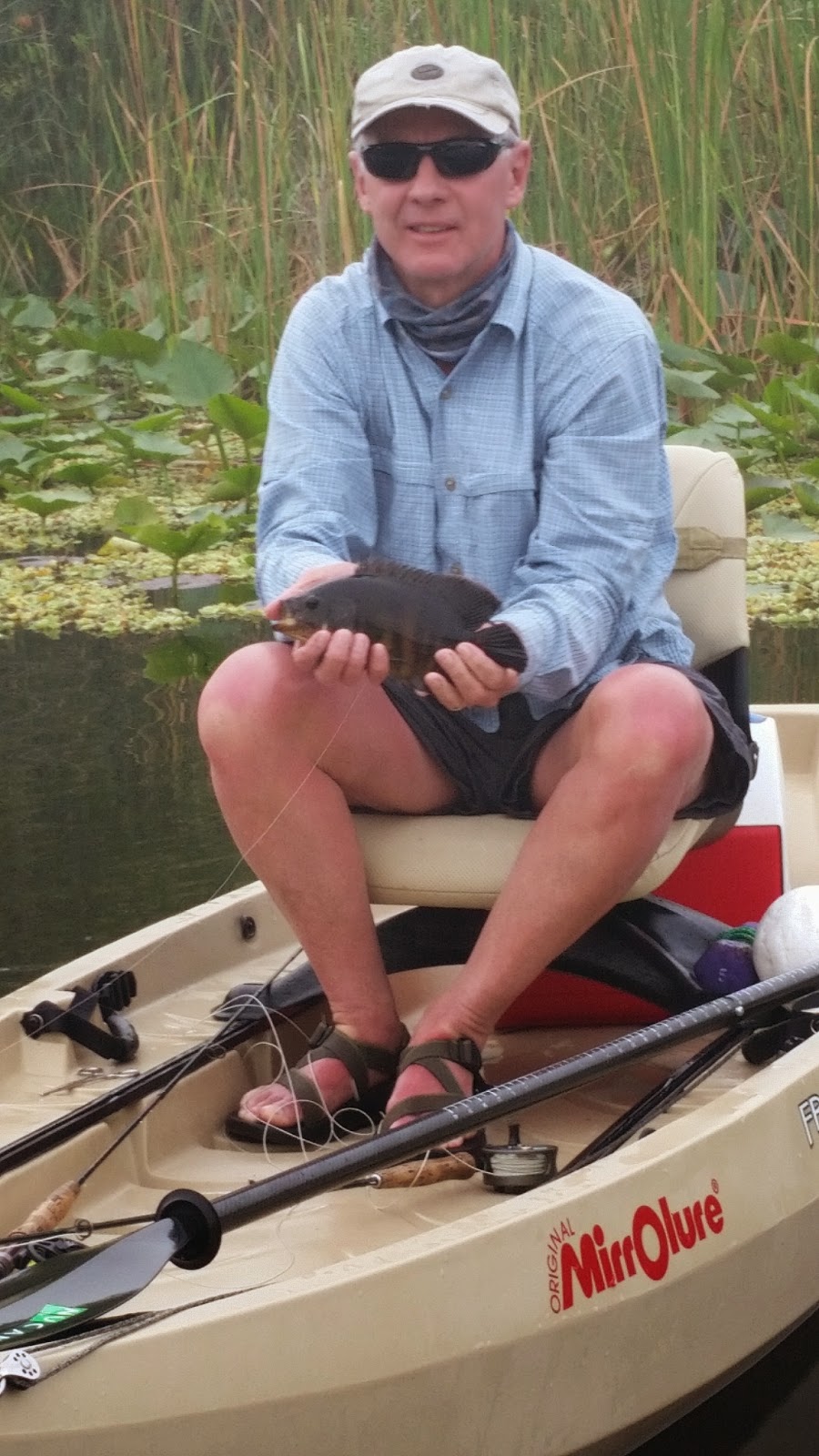
Halupka's first Mayan cichlid.
Key to success is figuring out a pattern.

To newcomers, everything looks the same. But to grizzled veterans, there are subtle differences. Shoreline cover along the canals consists for bulrushes, lily pads, rocks and trees. You have to figure out to what structure the fish are relating and home in on it. Once you figure it out, you can eliminate a lot of unproductive water.

On this outing, the fish were hanging out in small bays among the lily pads and around trees. So, we forgot all about the bulrushes and rocks.

Our tackle for the outing included 3- and 4-weight fly rods, floating lines, 7 1/2-foot leaders with 8-pound fluorocarbon tipper.

Fly of choice was Gibby's Myakka Minnow, one of the best panfish (and exotics) flies I've ever used. I tie the original Myakka Minnow and my new Myakka Minnow Jigs (1/124-ounce).

Conditions were simply perfect. There was little to no wind and it was overcast. When we found fish, we were able to stay on them with little trouble.

I fish out of NuCanoe Frontier 12s. They're simply the best fishing kayaks for fly anglers on the market. They're roomy, simple and unobtrusive. You can stand up and cast with ease.

Halupka ready to land an Everglades exotic.
One of the neat things about fishing from a kayak is that you don't have to make long casts. You can position your kayak within 20-25 feet of your target and simply flick your fly. Pick up the line and put it down.

No need for 50-foot or longer casts.

When fly fishing, I prefer to keep the bow of my kayak pointed in the direction of my target. In addition, I will put the tip of my fly rod in the water or near the water's surface. This eliminates slack line and you can feel all hits.

If the tip of your fly rod is a foot or more off the water's surface, there's a good chance you'll miss many hits. A fish can take the fly and spit it out without you ever knowing.

Oscar aren't large. They average maybe a pound. They grow up to about 4 pounds.

Don't let their size fool you. They're among the strongest fish in fresh water. That's why we've graduated to 8-pound fluorocarbon tippet. It's the only way we can keep from breaking off when oscar (and other fish) try to get back in the vegetation after they're hooked.

And, believe me, you'll still lose a few flies because you can't keep the fish out of the vegetation!
While fishing, I pay attention to what's going on around me. If I see a fish chasing minnows, I'll stop my retrieve, pick up my line and cast immediately. If you can get the fly to the active fish within a second or two, you have a good chance of hooking up.

On the latest trip, I saw fish making wakes heading to my flies a millisecond after it hit the water. This was my signal that something good was about to happen. On a least four occasions, I announced I was about ready to hook up -- and I did!

One time, I was watching Rob when I saw a huge wake heading toward where his fly hit the water. I told him he was about ready to hook up. He lifted the fly rod and was tight to a hefty oscar without ever feeling a hit.

"I didn't even notice the wake," he said. "I was watching my fly line."

Most of the time, all you have to do is to watch the end of your fly line. It's a built-in strike indicator. It might dart slightly to the left or right. Or might move forward. There's also the possibility that it might not move at all when you strip the line.

All mean you've probably got a fish.

On an average trip, you might catch up to 100 fish, half of which will be oscar.
These exotics can be traced back in south  Florida waters to 1954 when someone dumped the contents of their aquarium into a backyard pond or canal.

The rest is history.

While exotics might not be was fisheries biologists desire, they certainly have been a boon to those who fish those waters.

Be advised there are alligators in The Everglades.  For the most part, they will not let you get near them. They'll move off long before you're close enough to snap a decent photo.

Pythons are another concern. They're in The 'Glades, but I've never encountered one.

There are a number of recreation areas with boat ramps along Alligator Alley. You will find good fishing at every stop.

Essentials include cap or hat, sunscreen, polarized sunglasses and rain gear. If you have spent the winter up north and don't have a base tan, you might want to cover up with long-sleeved shirt and fishing pants.

Carry snacks, sandwiches and more water than you might think you'll need.

I have all-day trips to this fly-fishing paradise for $350 (one angler). The trip includes kayak, safety gear, paddle, all tackle and lunch. An extra angler is $50.

I fish The 'Glades from mid-December through May. After that the heat, rain and mosquitoes are unbearable.

If you've never caught oscar or Mayan cichlid, you should seriously consider allowing me to show you around .


Email me at steve@kayakfishingsarasota.com or call me at 941-284-3406.