Thursday, March 26, 2015

Trip to The Everglades is the perfect remedy after a slow day

Rob Halupka of Toronto battles an Everglades oscar on fly rod.
Rob Halupka and I experienced a very slow day in Sarasota Bay.

It was the slowest day I've encountered in my 10 years as a professional kayak fishing guide (www.kayakfishingsarasota.com).

Things picked up considerably the next day when we drove south to The Everglades.

Oscar that fell for a Myakka Minnow Jig.
Halupka booked three days of fly fishing with me while he and his wife were visiting from Toronto and staying on Longboat Key. One of the days was in The 'Glades.

Fishing is fishing, but when you have the opportunity to catch species that you've never encountered, you need to grab it. There are no oscar, Mayan cichlid or peacock bass in Ontario.

Fishing The 'Glades is an all-day affair. We met at 4:30 a.m. for the drive south. We arrived at our destination shortly after dawn.

I have fished there many times over the years. And I've had only a few sub-par outings. This wouldn't be one of them. We found the fish early and were able to catch them throughout the day.
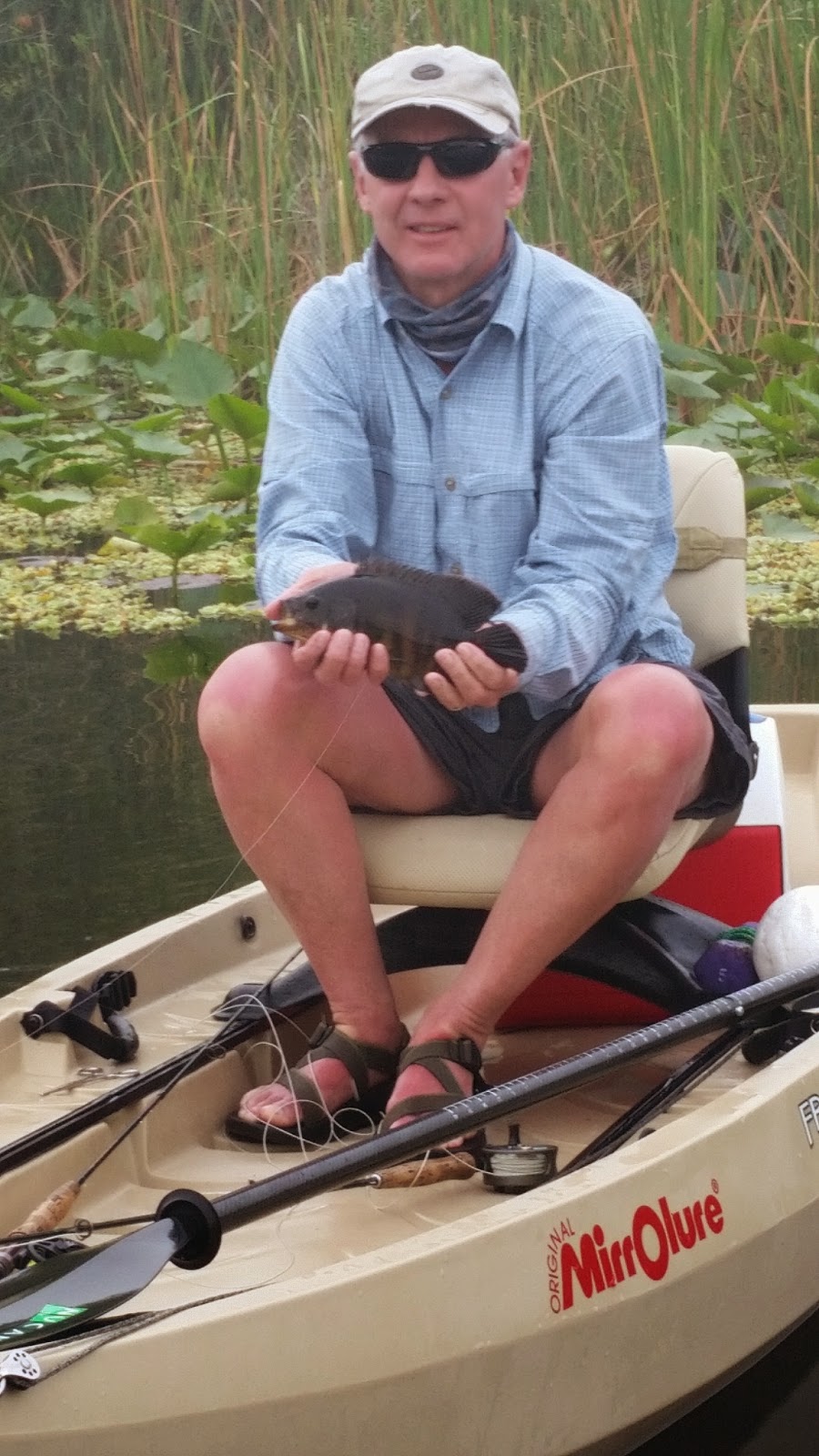
Halupka's first Mayan cichlid.
Key to success is figuring out a pattern.

To newcomers, everything looks the same. But to grizzled veterans, there are subtle differences. Shoreline cover along the canals consists for bulrushes, lily pads, rocks and trees. You have to figure out to what structure the fish are relating and home in on it. Once you figure it out, you can eliminate a lot of unproductive water.

On this outing, the fish were hanging out in small bays among the lily pads and around trees. So, we forgot all about the bulrushes and rocks.

Our tackle for the outing included 3- and 4-weight fly rods, floating lines, 7 1/2-foot leaders with 8-pound fluorocarbon tipper.

Fly of choice was Gibby's Myakka Minnow, one of the best panfish (and exotics) flies I've ever used. I tie the original Myakka Minnow and my new Myakka Minnow Jigs (1/124-ounce).

Conditions were simply perfect. There was little to no wind and it was overcast. When we found fish, we were able to stay on them with little trouble.

I fish out of NuCanoe Frontier 12s. They're simply the best fishing kayaks for fly anglers on the market. They're roomy, simple and unobtrusive. You can stand up and cast with ease.

Halupka ready to land an Everglades exotic.
One of the neat things about fishing from a kayak is that you don't have to make long casts. You can position your kayak within 20-25 feet of your target and simply flick your fly. Pick up the line and put it down.

No need for 50-foot or longer casts.

When fly fishing, I prefer to keep the bow of my kayak pointed in the direction of my target. In addition, I will put the tip of my fly rod in the water or near the water's surface. This eliminates slack line and you can feel all hits.

If the tip of your fly rod is a foot or more off the water's surface, there's a good chance you'll miss many hits. A fish can take the fly and spit it out without you ever knowing.

Oscar aren't large. They average maybe a pound. They grow up to about 4 pounds.

Don't let their size fool you. They're among the strongest fish in fresh water. That's why we've graduated to 8-pound fluorocarbon tippet. It's the only way we can keep from breaking off when oscar (and other fish) try to get back in the vegetation after they're hooked.

And, believe me, you'll still lose a few flies because you can't keep the fish out of the vegetation!
While fishing, I pay attention to what's going on around me. If I see a fish chasing minnows, I'll stop my retrieve, pick up my line and cast immediately. If you can get the fly to the active fish within a second or two, you have a good chance of hooking up.

On the latest trip, I saw fish making wakes heading to my flies a millisecond after it hit the water. This was my signal that something good was about to happen. On a least four occasions, I announced I was about ready to hook up -- and I did!

One time, I was watching Rob when I saw a huge wake heading toward where his fly hit the water. I told him he was about ready to hook up. He lifted the fly rod and was tight to a hefty oscar without ever feeling a hit.

"I didn't even notice the wake," he said. "I was watching my fly line."

Most of the time, all you have to do is to watch the end of your fly line. It's a built-in strike indicator. It might dart slightly to the left or right. Or might move forward. There's also the possibility that it might not move at all when you strip the line.

All mean you've probably got a fish.

On an average trip, you might catch up to 100 fish, half of which will be oscar.
These exotics can be traced back in south  Florida waters to 1954 when someone dumped the contents of their aquarium into a backyard pond or canal.

The rest is history.

While exotics might not be was fisheries biologists desire, they certainly have been a boon to those who fish those waters.

Be advised there are alligators in The Everglades.  For the most part, they will not let you get near them. They'll move off long before you're close enough to snap a decent photo.

Pythons are another concern. They're in The 'Glades, but I've never encountered one.

There are a number of recreation areas with boat ramps along Alligator Alley. You will find good fishing at every stop.

Essentials include cap or hat, sunscreen, polarized sunglasses and rain gear. If you have spent the winter up north and don't have a base tan, you might want to cover up with long-sleeved shirt and fishing pants.

Carry snacks, sandwiches and more water than you might think you'll need.

I have all-day trips to this fly-fishing paradise for $350 (one angler). The trip includes kayak, safety gear, paddle, all tackle and lunch. An extra angler is $50.

I fish The 'Glades from mid-December through May. After that the heat, rain and mosquitoes are unbearable.

If you've never caught oscar or Mayan cichlid, you should seriously consider allowing me to show you around .


Email me at steve@kayakfishingsarasota.com or call me at 941-284-3406.


Thursday, March 5, 2015

Here's hoping the weather has settled and the wind is manageable

Vinny Caruso of Bradenton, Fla., battles a feisty Everglades oscar on fly rod out of his NuCanoe Frontier.
February wasn't the best of months for Southern Drawl Kayak Fishing for a number of reasons.

Chief culprit was wind and cold weather. We often can prepare for cold weather by dressing warmly. 

Vinny Caruso's first peacock bass.
There's little we can do about wind.

For much of the month, we targeted spotted seatrout, perhaps the most plentiful species in Sarasota Bay and surrounding waters. We averaged more than 30 trout per trip, catching a high of 50 on one outing. Most of the fish were below slot (minimum 15 inches), but we did catch a few larger trout to 20 inches.

One highlight took place when we caught five pompano from one of our favorite spots in Buttonwood Harbor. That spot yielded strong pompano action the year prior. However, similar action hasn't materialized this time around. We caught the pompano on Vudu Shrimp (http://www.egretbaits.com/egret_vudushrimp.html).

We visited The Everglades on a couple of occasions and did well. On the first trip, we caught 50 oscar, 15 largemouth bass to 4 pounds, 20 bluegill and a pair of Mayan cichlid. All of the fish were caught on fly rod and Myakka Minnows.

If you fly fish and have never tried the Myakka Minnow, you should do so. I created this fly for panfish and other species about 10 years ago after a frustrating day on the Myakka River . You can read about it at: http://gibbysfishingblog.blogspot.com/2010/09/story-of-mighty-myakka-minnow.html

If you like to fly fish in fresh water, you should give the Myakka Minnow a try. You can order then from me. I am the sole source of Myakka Minnows in the country. Minimum order is a dozen. Cost is $60 (plus shipping and handling). I offer them in black, gold, copper and silver. To order, call me at (941) 284-3406 or email me (steve@kayakfishingsarasota.com).

The second trip to The 'Glades was interesting. Vinny Caruso of Bradenton, Fla., and I visited a spot along U.S. 41. The morning was chilly and the fish were hunkered down. We fished an hour without a hit. So, we loaded the kayaks on the trailer and headed for Alligator Alley.

We caught a number of fish early (Vinny caught his first peacock bass), including bass and bluegill. But the action didn't get going until it warmed up. That's when the action  exploded. We caught oscar, Mayan cichlid, largemouth bass, bluegill and shellcracker. I caught the largest bluegill I've ever caught in Florida. Vinny caught his largest shellcracker.

All fish were caught on Myakka Minnows.

A cold front moved through the following week, keeping us off the water for nine days. I used the time to tie flies, an activity I had been unable to do prior to my eye surgeries. With great vision, tying flies is now fun and easy!

I tied plenty of Myakka Minnows, plus Clouser Deep Minnows, Gibby's Trout Dusters, Gibby's Snook Flies and Gibby's Big Eye Baitfish.

I visited Tampa Bay on the Fly (www. http://tampabayonthefly.com/), a fine fly shop located in Tampa and owner by Enver Hysni. The shop is a great source for materials and equipment. I also visited Bill Jackson's (http://www.billjacksons.com/) in Pinellas Park, to pick up tying supplies.

When the weather settled, I returned to Sarasota Bay. Fishing off Stephens Point, I caught 32 spotted seatrout, two impressive Spanish mackerel and several ladyfish on MirrOlure MirrOdines (http://www.shopmirrolure.com/). I prefer the Mini MirrOdine (14MR) in most any color. This is my "go-to" lure in most saltwater situations.

Dave Robinson of Sarasota joined me for a day on Sarasota Bay. We launched at Buttonwood Harbor and did pretty well. We combined to catch 30 spotted seatrout to 20 inches, ladyfish and a pompano. A majority of the fish were caught on the 14MR MirrOdine.  A majority of the trout were slot fish (15 to 20 inches).

Richard Ives of Detroit and a buddy fished Buttonwood Harbor with me the next day. We caught plenty of trout, but most were under slot.

We're hoping the weather this month is better than February. We're looking for improved fishing.

MARCH FORECAST: We look for improved action on all fronts. Spotted seatrout, Spanish mackerel, bluefish, pompano, jack crevalle and ladyfish should be plentiful over the deep grass on the east and west sides of Sarasota Bay. Redfish action should improve on the flats, particular early in the day on topwater plugs and spoons. Night snook action is expected to heat up  around lighted docks. In fresh water, we anticipate strong action on fly rod in The Everglades for oscar, Mayan cichlid, largemouth bass and bluegill. Locally, bluegill, speckled perch, largemouth bass and channel catfish will cooperate on fly in Lake Manatee and the Manatee River.

March is a busy month and we're booking daily. Please contact me at your earliest convenience to schedule a trip.

Also, you can keep up with my activities by viewing my blog (http://gibbysfishingblog.blogspot.com/). I also report daily on Twitter (@gibby3474) and on Facebook.

We've added a GoPro camera to our arsenal and will begin adding video for you view pleasure.


Steve Gibson
Southern Drawl  Kayak Fishing
www.kayakfishingsarasota.com

(941) 284-3406

Friday, February 13, 2015

Fly Fishing in The Everglades along Alligator Alley should be on your bucket list

Vinny Caruso battles a feisty oscar on fly in The Everglades along Alligator Alley.
When I have some time off and I really want to catch fish on fly rod, I load the truck, hitch the trailer and head for The Everglades.

A typical Everglades oscar.
I've fished all over the state, country and internationally. Yet, some of my fondest fishing memories have taken place just 2 1/2 hours south of my home in Sarasota, Fla.

I really love fly fishing in The Everglades.

While most people might envision leaping tarpon, feisty snook and perhaps tenacious redfish, I forgo the salt for freshwater fly fishing in The 'Glades.

There, I encounter typical species such as largemouth bass, bluegill, shellcracker, speckled perch and stumpknocker.  But when I'm there, I target exotics species: oscar, Mayan cichlid and peacock bass.

Bass love the Myakka Minnow, too!
Several factors attract me to The 'Glades. I love the beauty and solitude. You can have a great day even when the action's slow. Those days are rare, however. Normally, you'll catch more fish that you could ever envision.  I also like the diversity. On one cast you might hook and fight a hefty largemouth bass. On the next, you  could tangle with a diminutive panfish that will make you think you've hooked a freight train. Oscar are perhaps the strongest freshwater fish I've ever encountered.

This trip is one that should be on your bucket list. However, it's not for those who arise late. We usually hit the road around 4:30 a.m. and fish until we've had our fill. For us, that's usually around 4 p.m.

We fish several areas along Alligator Alley, that portion of Interstate 75 that runs  between Naples and Fort Lauderdale. There are a number of recreation area/launch spots along the way -- and all offer superb action.

Vinny's first peacock bass.
We use 2- to 6-weight fly rods, floating lines and 7 1/2-foot leaders. Most often, we'll tie on a short length of 8-pound fluorocarbon tippet. You might think 8-pound tippet would be a bit too much for bluegill  and other panfish, but it's not.  You've got to remember that a majority of the fish are oscar -- and they're extremely tough.

For those unfamiliar with oscar (astronotus ocellatus), they're tropical fish that you'll typically find in freshwater aquariums. They were introduced to south Florida waters in the early 1950s when it's theorized an aquarium owner dumped their fish into a backyard pond or canal.

The rest is history.

Oscar can be found in most every freshwater body of water in south Florida. The species can't tolerate water temperatures lower than 55, so they are limited to living in south Florida.

The freeze of 2010 severely depleted oscar in south Florida, but they rebounded strongly. The population is up and the fishing is once again superb.

You can use a variety of flies when targeting oscar. They'll hit surface and sinking flies alike. However, I've found none better than my Myakka Minnow, an epoxy-bodied creation that's virtually indestructible. It mimics that tiny minnows that are plentiful in The 'Glades and are the main forage of most fish there.

The key to success in The 'Glades is to figure out the pattern -- which often changes from day to day.
On one trip in early February, I caught plenty of large oscar. But the real treat 15 pretty nice largemouth bass. I caught bass to 4 pounds on Myakka Minnows. Typical Everglades bass go 10 to 14 inches.

On my most recent trip, Vinny Caruso of Bradenton, Fla., and I launched our NuCanoe Frontier 12 kayaks at a recreation area in the Francis S. Taylor Recreation Area. We were just coming off a cold front and the air was brisk and sky blue.

It took us a couple of hours to figure things out. Oscar were sluggish because of the cold. When the air and water warmed in the early afternoon, we started catching fish -- but not in typical fashion.

Usually, we cast Myakka Minnows toward shoreline structure such as lily pads, bulrushes, rocks or trees and retrieve them fairly quickly. This retrieve wasn't producing -- probably because the fish were sluggish because of the cold.

We discovered the key by accident. I asked Vinny a question. When he turned my way to answer, he stopped working his fly and it slowly sank.

A few seconds later, our conversation  was interrupted when Vinny's line straightened and he turned his attention to a tenacious oscar.

Didn't take long for us to change our approach.

"Maybe they're trying to tell us something?" I said.

So, we began casting our Myakka Minnows toward the structure and simply let them fall. You'd notice the end of the fly line twitch or your line would simply straighten.

We caught a pile of fish in this manner, including 20 oscar, hand-sized bluegill, stumpknocker , largemouth bass and shellcracker.

Vinny even caught his first peacock bass, a species that was introduced to south Florida waters in 1984 by the state. It wasn't a large peacock, but it was memorable because it was his first.

I first began fish The 'Glades about 25 years ago. And I can tell you that great trips have outnumbered slow trips around 10 to 1. It's a rare day when the fishing is slow.

On most outings, we'll land more than 100 fish. We landed as many as 300 assorted fish on a number of occasions.

We fish The Everglades beginning in December and continue into May. We quit heading that way once the rainy season begins (usually in June).  When the rains begin, the water level increases and the fish then spread out over millions of acres. Plus, the south Florida heat and mosquitoes are intolerable.

When the rains stop, the water level goes down, concentrating the fish in canals. It's often like catching fish in a bathtub.

The trips rarely/never entail lengthy paddle. Typically, we begin fishing as soon as we launch. We'll drift, fish and concentrate around productive areas.

I've found the NuCanoe Frontier to be the perfect fly-fishing kayak. It's wide open, spacious and drifts nicely. There's nothing for the fly line to tangle on. And the cushioned, 360-degree swivel seat is most comfortable.

Fishing should remain strong over the next few months. If you've never experienced oscar and other exotics on fly, you'll want to do this.


Please give me a call (941-284-3406) if you have any questions or would like to book a trip. Or you can email me at steve@kayakfishingsarasota.com.


Saturday, January 31, 2015

Surgeries over, now it's back to fishing Sarasota Bay and other areas

Bill Haarz of Sarasota battles a fish on fly rod off Stephens Point in Sarasota Bay.
January was an abbreviated fishing month for Southern Drawl. I had two eye surgeries over nine days that diminished the time I could be on the water.

I'm happy to report both surgeries were successful. Not only do I not have cataracts, I also have great eyesight. For the first time in years, I don't have to wear glasses (except cheaters for reading). I went from nearsighted to farsighted in one fell swoop.

We fished Sarasota  Bay at Stephens Point on our first trip out after the surgery. Fishing was fair. We caught 15 spotted seatrout to 17 inches on MirrOlure MirrOdines. We also landed small snook, ladyfish and a juvenile barracuda on MirrOdines and MirrOlure Lil Johns on light jig heads.

We fished the Myakka River out of Venice Park, looking for bass. We didn't find them. We had five hits, but no fish.

We returned to the Myakka River out of North Port and fared slightly better  -- albeit not that much. Fishing with Vinny Caruso of Bradenton, we landed three small snook, three jack crevalle, a mangrove snapper, largemouth bass and a couple of ladyfish on MirrOdines and Lil Johns.

Everette Howell of Longboat Key and Nashville, Tenn., joined me for an outing on the Myakka River out of Snook Haven and we had a wonderful time -- but caught few fish. Over six hours of hard fishing, we landed on e bass, one snook and a gar.

Bill Haarz of Sarasota fly fished Sarasota Bay at Stephens Point and did fair. He had a snook inhale his fly on the first cast, but didn't hook up. He also had another snook hit the fly at another dock, but still didn't hook up. He landed a few trout and ladyfish over deep grass in the bay on Clouser Deep Minnows. We also caught ladyfish and a couple of Spanish mackerel.

A trek to Joe Bay resulted little action. Vinny Caruso and I combined to catch one trout, one jack and a ladyfish.

Wind shut us down for a week. It seems as if the wind has been a pest all month.

We finally got back out and visited Palma Sola Bay. Vinny Caruso and I caught 50 spotted seatrout to 17 inches, flounder and ladyfish on CAL Jigs with paddle tails, MirrOdines and Vudu Shrimp.

If you've never tried the Vudu Shrimp, you might want to. It's a small, weighted shrimp produced by Egret Baits (www.egretbaits.com) in Louisiana. I first tried this weighted shrimp out a year ago and did well.

I used a Vudu Shrimp to catch 30 trout and five pompano in Sarasota Bay near Buttonwood Harbor on my last trip out of the month.

Speaking of pompano, February could be a banner month for the tasty species. They showed up in good numbers last February and we were able to take quite a few fish on MirrOdines, jigs and flies. It looks like it could be an encore performance this time around.

Because of slow fishing, we probably won't be doing any more river trips this season. That's subject to change if the action picks up.

We're contemplating a few Everglades fly-fishing trips and shad trip to the St. Johns River. In the Everglades, we target oscar, Mayan cichlids and native species such as largemouth bass, bluegill, speckled perch, stumpknocker and warmouth.

When fishing The 'Glades, we primarily use light fly rods with floating lines. We use popping bugs, sinking flies and my Myakka Minnow.

We use light fly rods and typical shad flies on the St. Johns.

If you're interested in either trip, please let me know.

FEBRUARY FORECAST: Locally, we look for increased numbers of pompano over deep grass areas of Sarasota Bay. In addition, fishing for spotted seatrout, bluefish and Spanish mackerel should be good. Redfish action should be fair on the flats and along the edges. Snook action should be excellent at night around lighted docks.

Now that we're back in action and can see pretty darn good, please consider a February trip. Give me a call at 941-284-3406 or email me at steve@kayakfishingsarasota.com


Steve Gibson
Southern Drawl Kayak Fishing
www.kayakfishingsarasota.com

941-284-3406

Tuesday, January 6, 2015

A true kayak angler is hooked for life by a plastic boat

The author shows show a fine snook he caught from his NuCanoe Frontier while fishing on Sarasota Bay.
You're either a kayak angler or you're not.

There's really no in between.

From my experience, I've determined there are two types of kayak anglers: 1. Those who truly love the sport and recognize it as an effective way to stalk and catch fish; 2. Those who would rather fish from a boat but can't afford one (yet).

I'm among those in No. 1. I've owned boats, but can guarantee I'll never own another boat unless I'm physically unable to fish from a kayak down the road.

If you fall into the second category, you're really not a kayak angler. You're in transition.

I'm convinced that fishing from a kayak gives you the best opportunity to be catch fish. If the fish don't know you're there, you're ahead of the game.

Think about it for a second. A boat displaces water. That displaced water is transmitted out in the form of pressure waves. And those waves are warning signals to the fish. In addition, the fish can hear outboard-motor noise and electric trolling motors.

I'm not saying that powerboats are ineffective platforms from which to fish. I just believe that kayaks are much more stealthy and allow you to sneak up on fish.

In addition, you can get into areas that are unreachable by boat.

Gasparilla Sound is about 45 minutes south of my home in Sarasota, Fla. During winter, tides get extremely low around the new and full moons -- particularly if we have northeast winds. I can launch my kayak, paddle to Whidden Creek and have the area to myself until the tide turns and allows the bigger powerboats to enter. On occasion, I've fished four hours or more before seeing the first powerboat.

Catching fish is the prime reason I fish from a kayak. And let me advise you my production has gone up significantly since I made the conversion.

I first began kayak fishing in 1986. That was when you could hit your favorite body of water, paddle to your spot and never see another kayak. A lot has changed since the early days.

Today, kayaks are plentiful. I rarely make a trip without seeing other kayak anglers.

And there have been  multitudes of changes in the industry over the years. The biggest and best change has been the advent of the "fishing" kayak.

As you might imagine, people began kayak fishing out of whatever kayak was available. Typically, it was a sit-inside kayak (SIK). They're fine, but rather confining.

The manufacturers realized there was a whole new world out there and began producing sit-ontop kayaks (SOT). They were more open, more comfortable and better suited for fishing. They offered space for tackle and other gear.

And, as you might expect, the sit-ontops have evolved over the years.

Today, there's a veritable armada of choices in fishing kayaks.

I own a fleet of NuCanoe Frontiers. They're 12-foot boats that I feel are the best on the market when it comes to fishing. I love their simplicity, openness and stability.  With the NuCanoe's track system, you can add accessories to suit your needs.

The NuCanoe Frontiers is perfect for fly fishing. The open cockpit is the ultimate stripping basket. In addition, you can stand up to cast, which only serves lengthen your cast.

The Frontiers is 41 inches wide. That makes the boat the most stable in the industry. I've had clients in their 70s stand up and fish.

I've had people question the speed of the NuCanoe Frontier, implying that it's slow.  First, most of those questioning have never paddled one ("I've heard it's slow.").  Second, it paddles very easily. I've never had a problem keeping up with anyone.

In the fastest fishing kayak, you can consistently paddle 3.5 miles per hour. What's the big deal about speed anyway?

Standing up in a kayak is imperative for me. I carry a 9 1/2-foot push pole which I often use to slowly traverse a flat or edge to look for fish. I've found many hot spots by polling.

In fact, I found the mother lode of "gator" spotted seatrout by poling an edge in Sarasota a couple of years. While poling that edge, I looked down and saw what appeared to be a school of large snook lying on the sand bottom. But they turned out to be hefty trout.

I left (I'm sure they know I was there) and returned a couple of hours later. I caught and released a dozen trout from 4 to 6 pounds.

I've fished that area many times since and done pretty well. My best morning was when the smallest trout I landed weighed 6 pounds and the largest slightly more than 9!

I have a powerboat friend who rarely does much in that area. I'm sure the fish know of his presence long before he gets into casting range.

Of course, the biggest secret is to be on fish. If you're fishing where there are fish, you have a good shot at catching them.

Last summer, Vinny Caruso of Bradenton and I spent several weeks fishing southern Tampa Bay around Joe Island. The pattern remained steady from May to October. On almost every trip, we're drift off the western tip of Joe Island until we caught a fish and then anchor. We'd often catch good numbers of snook, spotted seatrout, redfish, bluefish and jack crevalle.

Kayaks are excellent platforms from which to "sight-fish." However, it's not sight-fishing in the traditional sense. Because you're not elevated, it's tough to see more than 15 or 20 feet.

What I like to do is anchor on the edges of sand holes or sand bars and cast to fish as they swim off the grass and into the open areas.

I've done it all in my kayaks: saltwater bays, estuaries, rivers, lakes. And I've caught fish all over the state.

All I need is a place to launch and a place to park.


I'm footloose and fancy free.

Saturday, January 3, 2015

December's action indicates large trout could be on the horizon

Amy Panse of Grand Rapids, Mich., shows off  a cobia she caught on a jig from Sarasota Bay.


If December is any indication, 2015 should be a banner year for spotted seatrout. After two years of below average trout fishing, things seem to be picking up.

Southern Drawl Kayak Fishing experienced fine trout action along the east and west sides of Sarasota Bay and around Palma Sola Bay.
Jeff Panse of Kalamazoo, Mich., caught a nice pompano.

Fishing on the north side of Helicopter Shoal, we caught 15 solid trout that ranged from 18 to 22 inches. We didn't catch any monsters, but we sure had the feeling that we would. Our bait of choice was the 14MR MirrOdine, the best trout lure we've ever used.

Trout action also was good in the deep grass off the east side of Whale Key. Vinny Caruso of Bradenton and I caught and released an estimated 50 trout from 16 to 20 inches on MirrOdines.

Norm Ferris of Charleston, S.C., joined us for a six-hour session and did well. Ferris, an accomplished fly angler, caught 20 trout and several ladyfish during his outing in Buttonwood Harbor. The highlight of the day was a fish that he didn't catch. Ferris saw a fish swimming along the surface about 50 feet from his kayak. He paddled into position to make a cast.

"It's a shark," he said, "and she's got a baby swimming along with her."

That shark turned out to be a 30- to 40-pound cobia.

Ferris made a nice cast to the fish. The big cobia immediately turned and began following the fly, but the fish turned away when it saw Ferris' kayak.

"I ran out of real estate," he said.

In addition to spotted seatrout, we've also been getting hard-fighting bluefish to 5 pounds, Spanish mackerel and a few pompano.

Jeff Panse of Kalamazoo, Mich., and his sister, Amy Panse, of Grand Rapids, Mich., joined me for a six-hour session off Stephens Point. It was one of those days that you dream about.

We launched the kayaks, paddled out to the deep grass and anchored when we hooked the first fish.

We didn't come off anchor for five hours. During that time, we caught more than 100 trout, plus bluefish, ladyfish, pompano and a cobia.

Amy hooked the cobia on a D.O.A. CAL Jig with a gold paddle tail.

"I think it's a shark," she yelled.

To the untrained eye, cobia often are mistaken for shark.

The cobia was a 30-incher.

Fly angler Jason Beary fished a half day on Dec. 26. We had to work hard, but managed to catch and release 30 trout and a couple of bluefish. The fish were taken on Clouser Deep Minnows.

We fished the Myakka River a few times, but didn't find the big snook. Best day was three small snook, three largemouth bass, a redfish and a gar.

We need some colder weather to kick the river season into gear.

I am out of commission until late in the month. I underwent eye surgery on Dec. 30 to remove a cataract from my right eye and to receive a new lens. The procedure was successful and I now can see after two years of "blindness."

I am scheduled to undergo surgery on my left eye later in the month.

I am not sure when my doctor will allow me back on the water?

Advancements in cataract surgery are amazing. Not only will I be able to see clearly again, but I also will not have to wear prescription glasses. I've been wearing glasses since I was 16.

I hope that all of you had a wonderful Holiday Season.

Most certainly I will be back on the water by late January. That's when I think the monster seatrout will be back. We haven't had a run of big trout since 2012. I'm looking forward to it.

Call me (941-284-3406) or email me (steve@kayakfishingsarasota.com) at your earliest convenience to book a trip. I look forward to getting out on the water with you once again.

FEBRUARY FORECAST: Spotted seatrout should not only top the list during the month, but we should encounter plenty of "gator" trout (5 pounds and heavier). In addition, I look for lots of feisty bluefish, Spanish mackerel, pompano and an occasional cobia. If the weather cools off enough, things should heat up in the Myakka River for giant snook. In the past, we've taken quite a few snook of 25 pounds and larger.


Steve Gibson
Southern Drawl Kayak Fishing
www.kayakfishingsarasota.com

941-284-3406

Wednesday, December 3, 2014

November saw improved action; December forecast good

Vinny Caruso of Bradenton battles a feisty oscar on a light fly rod in The Everglades. (Photo by Steve Gibson)
November proved to be just what was anticipate with improved fishing for a variety of species.

The highlight of the month was a trip to The Everglades with Vinny Caruso of Bradenton.

Typical oscar in The Everglades.
We met at 4:30 a.m. to make the 2 1/2-hour drive south. Our plan was to fish the canals along U.S. 41 (Tamiami Trail) south of Marco Island.

This was the first time that I left the kayaks at home on a trek to The 'Glades in several years.
Fishing that area by foot is something I've done many times, but not since 2004.

I chose to fish this particular area because I'd received word that water levels were up in The Everglades along Alligator Alley. And high water is not conducive to productive fishing in that area.
And with the wind predicted to be blowing around 15 mph, the Tamiami Trail would be perfect.

One of many largemouth bass caught on Myakka Minnow.
My usual "modus operandi" is to start fishing at the Turner River and work my way from spot to spot toward Miami. Fishing was so-so until we stopped at the fourth bridge. We didn't catch much at that bridge until we moved about 50 feet to the west. There we caught oscar on virtually every cast == until a pair of hungry (and healthy) alligators moved in to mooch free food.

We left and hit a couple of more bridges, but didn't have much success. So, we decided to fish along Loop Road, a scenic drive through The 'Glades.

One thing about Loop Road is there are plenty of gators. And this day was no exception. When you pull over to fish, you'd better check the side of the road before you get out. I don't know how many gators we saw sunning themselves along the road's shoulder.

Be sure to look before you exit the vehicle.
Typical strategy along Loop Road is drive from culvert to culvert (there are many) and stop at the ones that look good. I'd drive slowly as we approached a culvert, and Vinny would look out the window to determine is the spot was holding enough fish to stop.

We did fair on the first three stops. It was a different story on the fourth. I'm not sure how long we fished, but I'd estimate it was at least four hours. And we caught fish on literally every cast. I couldn't give you an accurate count on our fish, but I'd guess we landed 100 oscar, 12 largemouth bass, a half dozen hand-sized bluegill, several Mayan cichlid, gar and stumpknocker.

For this type of fishing, we use 3- and 4-weight fly rods, floating lines and 8-foot 6-pound leaders. Fly of choice was my ever-trusty and amazing Myakka Minnow.

The oscar, an exotic species that was inadvertently introduced to south Florida waters in 1954, was larger than average along Loop Road.

If you'd never hooked an oscar, you're missing out. They're not doubt the strongest fish for their size around. They're gregarious, strong and bulldog-like. You often wonder if you'll be able to land them.

We usually release all fish, but Vinny decided to take a few oscar home to sample. The fish are thick and produce sizeable fillets.

He sautéed the fillets in olive oil and garlic. He said the fish were superb. And since there are no size or bag limits on oscar, he plans to keep them on subsequent trips.

Whether fishing The 'Glades by foot or by kayak, the action usually is fast and furious. This is a wonderful trip that is among my favorites. The action usually is best December through April. Cost is $350 and that includes tranportation and lunch. Add $50 for an extra angler. There's an optional stop at the Bass Pro Shop in Fort Myers free of charge.

On Everglades trips, I don't fish by the clock. We arrive shortly after daylight and fish until you say it's time to go. If you want to fish until dusk, that's OK.

Closer to home, fishing finally picked up in Sarasota Bay. We caught slams (redfish, snook, spotted seatrout) on several occasions around Buttonwood Harbor on the west side of the bay. On a couple of occasions, we were able to "sight-fish" all three species on the flats and in sand holes on the incoming tides.

We caught snook to 28 inches, reds to 32 and trout to 26.

In addition, we caught several hard-fighting bluefish to 5 pounds, a couple of pompano and a black drum.

We fished southern Tampa Bay behind and in front of Joe Island on a couple of occasions and caught a variety of fish, including redfish, spotted seatrout, snook and doormat flounder.

I ventured up to the Palma Sola Bay and did well. We caught 89 trout to 22 inches, six flounder, two redfish, a pompano and several ladyfish and jack crevalle -- all on D.O.A. CAL Jigs with gold paddle tails.

I have several openings early this month, but the schedule is filling quickly around Christmas. In addition, I am scheduled for eye surgery on Dec. 30 and then again about a week later, so I will be out of commission for a few days during that span.

Please feel free to email me or give me a call if you'd like to book a trip or if you have any questions.

DECEMBER FORECAST: I look for increased numbers of bluefish, Spanish mackerel and pompano off the edges of the flats around grass patches in the deeper water. This action is great for spin and fly anglers. Spotted seatrout action should continue steady. Snook are in transition, migrating from the bays to creeks, canals and rivers where they'll spend the winter. I look for decent snook action in local rivers from mid-December through Feb. 15. Over the last few years, river fishing has produced snook to 44 inches (about 28-30 pounds). In addition to snook, we also catch redfish, largemouth bass, tarpon and gar in the river.

Happy Holidays!


Steve Gibson
Southern Drawl Kayak Fishing
www.kayakfishingsarasota.com

941-384-3406