Monday, September 24, 2012

Redfish and trout the highlights of September


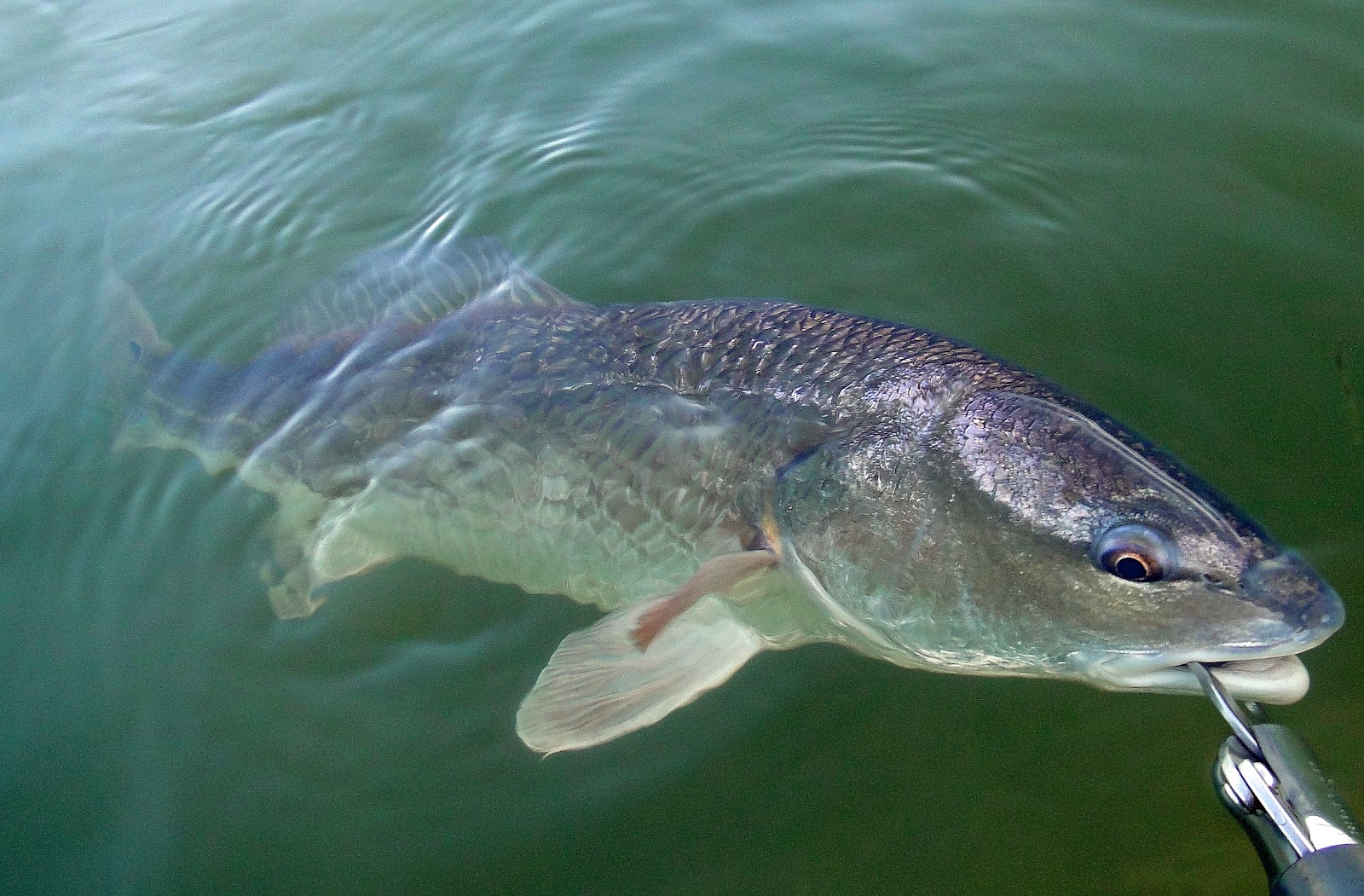
Sarasota's Dave Robinson shows off one of seven redfish he caught just north of Long Bar.

Jim Shuford of Sarasota had never caught a redfish on an artificial lure.

That ended shortly into his half-day outing to Buttonwood Harbor off Sarasota Bay. Shuford caught and released a hefty redfish while casting a MirrOlure Little John on a 1/16-ounce jig head.

Shuford was one of many clients and friends of Southern Drawl Kayak Fishing to catch redfish during the month.

In addition to redfish, Shuford had a fair day, catching and releasing spotted seatrout and jack crevalle.

Repeat clients John Mallia and J.D. Mallia of Lancaster, N.Y. had a decent day in the Buttonwood Harbor area. They caught and released 50 spotted seatrout to 2 ½ pounds, redfish to 20 inches and several mangrove snapper. The fish were caught on MirrOlure Little Johns on light jig heads and MirrOlure MR14 MirrOlures.

Zack Dunivin, a student at New College in Sarasota, caught a variety of fish while casting jigs around grass patches near Stephens Point in Sarasota Bay. Dunivin caught spotted seatrout to 17 inches, flounder, mangrove snapper and a 26-inch snook. Most effective lure was a MirrOlure Little John on a light jig head.

Mike Milby of Washington, D.C., and Josh Milby of Lakewood Ranch had a tough day along the east side of Sarasota Bay and just north of Long Bar. They totaled three redfish, a snook, 15 spotted seatrout to 18 inches, ladyfish, jack crevalle and a few ladyfish. Most of the fish were caught on gold spoons or MirrOlure MR14 MirrOdines.

Dave Robinson of Sarasota joined me on a couple of outings. We fished Charlotte Harbor, the mouth of the Peace River and the Punta Gorda Isles canals. Our target was tarpon and we found plenty. But we couldn’t get them to hit.

I had fished the canals the previous week and jumped a couple of juvenile tarpon on D.O.A. TerrorEyz.

Tarpon fish ranges from frustrating to great during this time on year in Charlotte County. I’ve jumped as many as eight tarpon in a morning. I’ve also had some not-so-good days.

Robinson and I made the 45-minute paddle to Long Bar and fared better. We combined for 11 redfish, four snook, plenty of trout to 4 pounds, mangrove snapper, jack crevalle, flounder and ladyfish. The redfish ranged from 24 to 28 inches. Top snook was 25 inches. The fished were caught on gold spoons, MirrOlure MirrOdines and artificial shrimp.

Highlight of the day came in early afternoon when Robinson hooked and landed a tailing redfish.

October’s forecast calls for cooling temperatures and improved fishing. We look for continued redfish success on the shallow flats.

Spotted seatrout are expected to remain plentiful.

Night snook action should be good around light docks. Plus, we should encounter a few larger snook on the flats.

GIBBY’S TIP: If you’re looking for redfish, make sure the flat you’re fishing has plenty of marine life: mullet, crabs, shrimp, worms and baitfish. I look for large schools of mullet and concentrate my effort around them. For this, I like to fish topwater plugs, MirrOlure Little Johns on light jig heads, MirrOlure MirrOdines or gold spoons.

We’re booking up for October, but still have some prime dates left. Please give us a call or drop us an email if you’d like to get out on the water and have some fun.


Steve Gibson

Southern Drawl Kayak Fishing

www.kayakfishingsarasota.com

http://gibbysfishingblog.blogspot.com/

(941) 284-3406


Monday, September 3, 2012

Redfish and snook come on strong in August

Pete Walocko of Michigan caught the 28-inch snook on his first cast.


Just as predicted, redfish were the fish of the month  for Southern Drawl Kayak Fishing.

We totaled 62 reds during August, a majority of which ranged from 25 to 30 inches. We had two days during which we landed 10 redfish.

Top bait was the MirrOlure Little John on a 1/16-ounce jig head.

Most of the action took place on the shallow flats of Buttonwood Harbor off Sarasota Bay. The light jig head allows us to fish the shallow grass without constantly hanging up.

In addition, we caught redfish on MirrOlure She Dogs and MirrOlure MirrOdines.

Vinny Caruso of Sarasota fished three times and totaled several redfish and spotted seatrout. His best red, which came on a Sebile Stick Shad, went 26 inches. He also caught reds on a chrome Zara Spook.

Vinny and I tested Bishop Harbor and southern Tampa Bay on one outing, but had to dodge thunderstorms. We only managed a few seatrout.

Pete Walocko of Michigan fished one of those rare days when the redfish weren’t cooperating. But he was fortunate enough to catch a 28-inch snook (released) on a Little John and jig head. He also caught a number of seatrout on the same lure.

We’re finding most of the redfish in and around mullet schools. The more mullet, the better.

We’re also starting to get into some nice flounder on jigs fished along grass edges. Flounder action is expected to heat up and peak in November. We anticipate a good number of flounder to 24 inches.

Although the peak season for large spotted seatrout has passed, we’re still getting some quality fish. In fact, we landed a pair of 4-pound trout on one trip. The top lure for big trout is the MirrOdine, a suspending plug that the fish just can’t seem to resist.

We’re getting more snook than usual on the Buttonwood flats. The action isn’t great, but it’s better than it has been since the red tide of 2006.

We fished Little Sarasota Bay one day on a whim and did very well. We landed seven redfish to 25 inches, four snook to 23 and 15 trout to 18. The reds were all caught on Little Johns.

There are some large schools of oversized redfish on the flats – if you can find them. Best areas include Buttonwood Harbor and southern Tampa Bay.

Snook continue to please around lighted docks at night. A good plan is to start fishing a couple of hours before daylight. We get in a little snook fishing, then hit the bay for reds, trout and other species. On occasion, it’s possible to take a Slam (a red, trout and snook) around the dock lights.

Beach snook fishing has been disappointing with high winds, red algae and stirred up surf. That seems to have dissipated and we could experience a late-season flurry of snook action in the surf.

I have ordered my new fleet of kayaks. I’m getting three Native Watercraft Ultimates and a Native Watercraft Slayer 14.5. The Slayer is a new design that is expected to hit the market in October.

I have three Native Watercraft Ultimate 14.5s for sale. I’m asking $750 for my personal boat. It has a bow spray skirt, paddle holder and anchor trolley. The other two are $700 and only have anchor trolleys.

If you’re interested, please let me know as soon as possible. I am offering them to clients and friends first. Then, I will list them publically.

We anticipate good redfish action this month. In addition, we expect snook, spotted seatrout, bluefish and maybe pompano to cooperate.

The fishing has been very good. Contact me if you’d like to fish.


Steve Gibson

Southern Drawl Kayak Fishing

www.kayakfishingsarasota.com

941-284-3406

Saturday, August 11, 2012

Now is the time for exciting redfish action on the shallow flats


Finding mullet on the flat is one of the keys to finding redfish.

Vinny Caruso shows of a Sarasota Bay red.

Redfish are highly sought along Florida’s west coast. They’re hard-fighting, savvy and very strong.

Late summer and early fall are great times to hunt for reds on the flats along coastal Florida. That’s when redfish start gathering in schools to make their annual spawning run into the Gulf of Mexico.

We like to get on the water before daylight so that we’re where we need to be when the action gets started. Don’t want to be paddling when we should be fishing!

But there’s a nice solitude on the water before the sun rises. The air is warm and the breeze usually gentle. You can hear the sounds of mullet jumping. You can hear pelicans and other birds beginning their days.

When targeting reds, I like to have a variety of lures ready to go. On one rod, I’ll have a topwater plug. I’ll use a jerk worm on a light jig head on another. On the third rod, I’ll go with a MirrOlure MirrOdine. All three are proven redfish catchers. You won’t go wrong with a spoon, either.

When I get to a flat, I look for signs of life: mullet, baitfish, crabs, stingrays. If the flat is alive with those things, then you’ll usually find redfish.

I think mullet are the key, though. If the flat is filled with mullet, you can get the reds are nearby.

I usually begin with a topwater plug. I like the Zara Super Spook Jr. in chrome. I use a Hurricane Redbone 7-foot medium-action rod, Shimano Reel and 10-pound Fins Wind Tamer line. Key to redfish success on the Spook is being able to “walk the dog.” That’s a zig-zag pattern when the lure is being retrieved.

To do this, I hold the rod parallel to the water to my left and begin “twitching” the rod as I reel. It’s kind of like rubbing your head and patting your belly. It’s tough at first, but easy once you get the hang of it. You can speed up or slow down the speed of your retrieve or the speed of your lure.

A big key in successful topwater fishing is the NOT set the hook when you see a strike. Only set the hook when you feel the weight of the fish. I just keep working the lure until I feel the fish. It’s tough to refrain from setting the hook when you see a big redfish explode on your plug.

When a fish strikes the plug and misses, I just keep it coming. Often, a big redfish will hit the plug several times before it’s hooked.

There are times that I’ll stop the plug when a fish misses it. I think the fish slap at it to stun it. I let the plug sit for a couple of seconds and then start working it. This often elicits explosive strikes.

If the fish are “short-striking,” I’ll change tactics. Sometimes I’ll pick up a jerk worm and toss it to the spot of the short strike. That often produces a quick hookup.

Just the other day, Vinny Caruso and I were fishing a Sarasota Bay flat at a spot where we’ve been catching quite a few reds. But there was little going on. The mullet weren’t moving and it was relatively dead. The tide was really high and there was a lot of water on the flat.

About mid-morning, we noticed mullet beginning to move about 100 yards away. Vinny paddled toward them and cast a plug. He immediately hooked a nice red. When he lost the fish, he called me over.

I hooked a small red on my first cast. I was using a MirrOlure Lil John on a 1/16-ounce jig head. Vinny caught a red on his plug.

On my next cast, I hooked and landed a 25-inch beauty on a MirrOlure MirrOdine, a plug that really works well for shallow-water reds.

Key to our success was finding the mullet. We landed three out of five fish we hooked. Our window of opportunity closed after about 20 minutes, but we succeeded. Some might say we were lucky, but we feel luck is when preparation meets opportunity!

And we were prepared.

The larger redfish should start schooling soon. They’re the sexually mature fish that will eventually move out into the Gulf of Mexico and never return. The schoolers usually run 30 inches or more.

Two years ago, I found several schools of big redfish in Sarasota Bay and Tampa Bay. I remember a day in Tampa Bay when I found a school of about 100 reds just off a sand bar. I caught eight big fish out of the school before a pair of hefty bull sharks moved in and brought the action to a halt.

When you find a school, it’s usually and automatic hookup. All you have to do is toss a lure to the edge of the school and hang on! I try to avoid casting into the middle of the fish.

When the fish are schooled, most any lure will work. Topwater plugs, however, draw the most-exciting strikes.

Fighting a big redfish in a kayak is a fun experience. These fish are big enough to take you for a ride! They can tow the kayak for quite a distance.

When we’re concentrating on redfish, we’re not thinking “numbers.” Three reds in a day is good. These fish rarely just “jump in the kayak!” We often do better.

If we could select the tide, we’d prefer to have it still trickling out at the start of the day. We like to fish the last hour of the outgoing and first couple of hours of the incoming. But the tide changes daily and that’s not always possible.

But if we can find the mullet schools, it usually doesn’t make any difference!

Saturday, August 4, 2012

Redfish, trout and snook headline July action

Redfish action heated up in July and is expected to peak in August. This red was caught on a topwater plug in Sarasota Bay.

Spotted seatrout, snook and redfish were the mainstays of July, a month that saw unseasonable westerly winds.

Top spots for Southern Drawl Kayak Fishing included Buttonwood Harbor and Stephens Point.

We also fished a couple of days on Tampa Bay out of Bishop Harbor and scored on some large seatrout.

Fly angler Jack Feldstein fished a half day and managed mostly spotted seatrout. Fishing the east side of Sarasota Bay just north of the Ringling Mansion, Feldstein caught mostly undersized (less than 15 inches), but did manage a 3-pounder on his first cast of the morning. All fish were taken on chartreuse-and-white Clouser Deep Minnows.

Randy Ruskey and sons Eric and Jon joined me for an outing at Stephens Point. We were met by strong westerly wind that prevented us from venturing into Sarasota Bay. However, Randy Ruskey landed a 23-inch snook on a Gibby’s Snook Duster while fishing around a lighted dock.

We fished the bowl at Stephens Point and did fair. Eric Ruskey landed a pair of snook, including a 27-incher. Both fish fell for a 1/16-ounce CAL Jig with a gold paddle tail. We also landed three flounder to 18 inches on jigs.

Fred Hart joined me for a half-day outing off Stephens Point and had a fair day. He landed several trout and ladyfish on CAL Jigs.

Erick Ruskey and Jon Ruskey, both from Illinois, fished with me at Buttonwood Harbor and had a fun day. They both caught a number of spotted seatrout on CAL Jigs. Jon also landed a small redfish on a topwater plug. In addition, we caught ladyfish, mangrove snapper and flounder.

Later in the month, redfish began to cooperate at Buttonwood Harbor. We caught several upper slot (18 to 27 inches) reds on topwater plugs, MirrOlure MirrOdines and CAL Jigs with D.O.A. 4-inch jerk worms. Best day was five reds to 30 inches.

Vinny Caruso of Sarasota joined me for a fun day of topwater fishing. We combined 25 trout to 4 pounds and a pair of flounder on Zara silver Super Spook Jrs., and MirrOlure MirrOdines.

I did a solo venture recently and found some big reds around mullet schools. I caught four redfish on MirrOlure MirrOdines, Zara Super Spook Jrs., and MirrOlure Lil Johns on light jigheads.

Dave Robinson of Sarasota joined me on the last day of the month for a backcountry outing. Testing out his new Native Watercraft Versa Board, he did well. We combined for six redfish to 27 inches and a number of trout to 4 pounds on MirrOlure MirrOdines, Zara Super Spook Jrs., and MirrOlure Lil Johns on light jig heads.

Beach snook fishing has been pretty much non-existent because of wind and rough surf conditions. That could change this month. August traditionally is a good month for beach snook for both fly and spin anglers.

Night snook action continues strong around lighted docks.

My schedule is filling up nicely. Be sure to book your trips early to assure an outing.


Steve Gibson


Southern Drawl Kayak Fishing


www.kayakfishingsarasota.com

http://gibbysfishingblog.blogspot.com/

(941) 284-3406

Thursday, June 21, 2012

A good fly is easy to tie and catches fish

Gibby's D.T. Variations are easy and quick to tie, plus they really appeal to snook in the surf.
A good fly is one that catches fish.

A good fly also is one that is easy and quick to tie.

I was surfing the Internet a year ago or so when I found a good-looking fly that I thought might work well on redfish. When I investigated further, I discovered there were 62 tying steps involved in tying that fly.

Too many for me!

My D.T. Variation, perhaps the best fly I’ve found for sight-fishing snook in the surf, is a classic example. It’s very easy to tie and it has accounted for several thousand snook over the years. There are only five tying steps and it takes only a few minutes to tie.

What more could you want?

Too many times, fly tyers get too complicated in their designs, trying to mimic baitfish, crabs, shrimp and other food to perfection. Exact imitation isn’t necessary or even desired in the salt.

Remember this adage: Hungry fish plus good presentation equals hookup.

Simple.

I remember one winter when I discovered a shrimp pattern that I thought would be the cat’s meow for snook in the surf. It looked exactly like a live shrimp.

I spent a couple of weeks tying up a bunch and was sure I had the “magic fly.”

First time out, I was disheartened when snook after snook ignored the realistic pattern.

What I’ve discovered is that you really don’t want to give the snook (or any fish) time to study your fly. Let them see it, then try to get it away from them.

When sight-fishing snook in the surf, I’ll strip the fly in front of the fish. When the snook turns to follow, I’ll speed up the retrieve to trigger the strike. This is where most anglers slow their retrieve.

Big mistake.

Try to get that fly away from the snook. If the fish wants it, you can’t strip too fast.

I’ve spent the last 30 years sight-fishing snook in the surf and I’ve learned a thing or two. Your success is directly correlated to your ability to see the fish. If you can see them, you’ve got a chance to catch them.

When I first started beach snook fishing, I used Lefty’s Deceivers, one of the most-famous saltwater flies ever. However, Matt Hoover, a guide in Naples, Fla., sent me a well-used D.T. Special and said that “it’s the only fly you’ll ever need for snook in the surf.”

He was right.

I’ve tweaked the fly over the years to fit my needs, adding eyes, a touch of red and epoxying the head. My version is called Gibby’s D.T. Variation. I did not design or invent the original D.T. Special. I take no credit for that.

My D.T. Variation is a little tougher and lasts a little longer than the original D.T.

Both are effective flies for sight-fishing snook in the surf.

Best of all, they take little time to tie.


GIBBY’S D.T. VARIATION

Hook: Mustad 34007 No. 1 to No. 4

Thead: White flat-waxed Monochord

Tail: Four white neck hackle (two on each side) facing (not splayed).

Flash: Pearl Krystal Flash

Collar: White neck hackle (palmered)

Eyes: 3D Prism Stick-On.

Epoxy: Devcon 2-Ton

Thursday, May 31, 2012

Snook top the list and should improve in June

Eric Porter of Denver, Colo., is all smiles after landing his largest snook ever on fly.
May was snook month for clients of Southern Drawl Kayak Fishing.

Snook, arguably Florida’s most popular inshore gamefish, were hurt by the severe freeze of 2010. That’s when fisheries biologists estimated that 10 percent of the snook along Florida’s west coast may have perished because of the cold.

However, the species seems to have rebounded and is doing well.

We’ve been targeting snook around lighted docks at night or before dawn, on the flats at sunrise and along the beaches. Best action has been around the docks lights, but beach snook action is improving daily.

Eric Porter of Denver, Colo., and his brother, Jeff of Oklahoma City, Okla., both repeat clients, scored on fly rods early in the month, fishing around lighted docks. Using my night snook fly, they each caught snook and had shots at others. Eric Porter’s 27-inch snook was the outing’s top fish.

In addition, Eric Porter landed a 3-pound spotted seatrout on Gibby’s Duster.

His snook and trout were the largest that he’d ever caught on fly.

New kayak angler Dan Benbasset of Riverview, Fla., had a nice introduction. We fished the Buttonwood Harbor area and did well. Dan caught a number of spotted seatrout on D.O.A. CAL Jigs with gold paddles tails and on Zara Super Spook Jrs. He also caught a bonnethead shark and several ladyfish.

Jeff Voigt of Spokane, Wash., and Lloyd Dyer of Saskatchewan had a fair outing. The fly anglers caught snook and spotted seatrout around lighted docks and nearby grass flats on my night snook fly, Gibby’s Duster and Clouser Deep Minnows.

Mike Green of Cartersville, Ga., caught a load of spotted seatrout and a few ladyfish on D.O.A. Deadly Combinations (popping cork and D.O.A. Shrimp) while fishing Buttonwood Harbor north and east of Whale Key.

John Anderson of Portland, Ore., did well on spotted seatrout, flounder and ladyfish on the D.O.A. Deadly Combination at Buttonwood Harbor. He fished two days in a row and did well. We tried for redfish on the second day, but didn’t hook up.

The Deadly Combination is a great lure this time of year. Simply tie a fluorocarbon leader below the float (clacker) and adjust it for the depth you’re fishing. Add a D.O.A. Shrimp or jig below it and you’re set.

It’s an easy and productive rig to use. I cast it out, allow the shrimp to sink, and then reel in the slack and give the float/clacker and couple of sharp tugs. The noise attracts predator fish. When they swim up to investigate, they see the shrimp and usually inhale it.

When the float/clacker goes under, reel up any slack and set the hook.

This rig has produced trout to 7 pounds for me.

Jeff Voigt and Lloyd Dyer joined me again after their trek to southern Florida. This time, they fished the beach for snook. They each caught or hooked snook on Gibby’s Hare of the Snook Fly.

Even Burck of Washington and A.J. Gottschalk of Buffalo, N.Y. fished the beaches with me and caught small snook on D.T. Variations.

Snook are plentiful along the beaches, but the bite hasn’t been great – yet. The action should pick up as we move into summer.

Those booking beach snook outings usually get a shot at 200 snook or more, including some whoppers.

We’ve been encountering schools of 15 to 30-pound snook. The big fish do not eat very often, but they can be taken on fly. Largest fly-rod snook we’ve hooked and landed over the years is a 40-incher.

In addition to snook, we sometimes encounter spotted seatrout, flounder, ladyfish, jack crevalle, redfish, mangrove snapper, houndfish and (occasionally) tarpon.

The June outlook calls for continued increase in snook along the beaches, good to excellent fishing for snook at night around dock lights, good topwater action on redfish in shallow water and plenty of spotted seatrout over the deep grass areas of Sarasota Bay.

As always, I want to thank my sponsors: Native Watercraft, D.O.A. Lures, Temple Fork Outfitters, Aqua-Bound Paddles, Economy Tackle and Peak Fishing.

Call or email me to book a trip.


Steve Gibson

Southern Drawl Kayak Fishing

www.kayakfishingsarasota.com

http://gibbysfishingblog.blogspot.com/

(941) 284-3406


Thursday, May 10, 2012

Snook are hungry and willing when the sun goes down

Can you tell Eric Porter of Colorado is a happy camper after landing this fine snook on fly rod?
Hungry snook gether by a light at night.
As many of you are aware, we recently began offering night snook charters. It’s a great way for beginners and veterans alike to fish for snook in exciting conditions.

Our success rate to date has been very good, with several anglers getting either their first snook on fly, largest snook on fly – or both!

We launch the kayaks at night. After a short paddle, we arrive to fish lighted docks. The lights attract shrimp and baitfish, which, in turn, attract snook, spotted seatrout and other predator fish.

One spot that I fish has eight lighted docks, all of which hold fish.

I’ve got one client who doesn’t want to fly fish for snook at night.

“Too easy,” he said. “Like shooting fish in a barrel.”

I have other clients who quickly will disagree.

Reason is that night snook fishing requires pinpoint accuracy and several of the docks present tricky casting problems. A typical overhead cast just won’t work in many cases.

Sometimes, you have to get the fly under a dock or right next to a piling. To get the fly under a dock, you must change your casting place from overhead to sidearm. The cast is the same, but the plane is altered.

Since I use Native Watercraft Ultimate 14.5 kayaks, there’s ample room in the cockpit for the fly line. In fact, I call the kayaks the world’s largest stripping baskets! When I strip the line in, I let it fall into the cockpit right between my legs. This prevents the fly line from floating out in the water and tangling around pilings or debris.

I also advise pointing the bow of the kayak toward your target and retrieving the fly in a straight line back to you. Your rod tip should be in the water or on the water’s surface.

Some anglers will retrieve the fly with the rod tip 18 inches above the water. That’s 18 inches of slack you have to remove before you can move the fly or set the hook. If your rod tip is on the water’s surface, there is no slack. If a fish hit, you’re directly connected and ready for action.

For night snook fishing, I like an 8-weight fly rod with a full floating line. I use a 9-foot leader with 20-pound shock tippet. I’ll go with a heavier tippet – 25- or 30-pound – if the bite is aggressive or the fish are larger than normal.

The average snook is about 23 inches. However, we’ve been getting snook to 30 inches or more on almost every trip. Sometimes, however, it’s tough to get your fly through the smaller fish to get a larger snook.

Fly choice isn’t really a big deal. I prefer a small shrimp or baitfish imitation on a No. 4 or No. 6 hook. Color choice is white. I do smash the barbs on the hooks so that I don’t hurt the fish.

Trickiest part of night snook fishing is learning to back-paddle while you’re fighting the fish. Remember, you have to get the snook away from the dock and pilings. To do so, you must hold the rod in one hand, and back-paddle with the other.

Most anglers get the hang of it quickly.

On a recent solo outing, I caught and released six snook to 28 inches and four seatrout to 19. It was a fun morning.

I have had outings where I’ve caught a Slam (snook, trout and redfish) on fly before dawn.

The fishing slows down drastically as soon as light appears in the sky. That’s when it’s time to go home or head out to nearby flats. On recent outings, Terry Rychlik of Connecticut caught several nice trout and a decent snook on the flats. Eric Porter caught several trout, including his largest, a plump 3-pounder.

Wind and tide are what affect night snook action. Usually, I just like a strong incoming or outgoing tide. Too much wind simple makes casting and positioning a little more difficult.

Night snook fishing also is a great way to beat the Florida heat. You can catch snook in the cool of night. When the sun comes up, it’s time to head home. And you will be in the pool, sipping a Rum Runner or Mojito by noon.

If you’re interest in a night snook trip, give me a call at (941) 284-3406 or email me at steve@kayakfishingsarasota.com.

Come catch your first snook with me!